

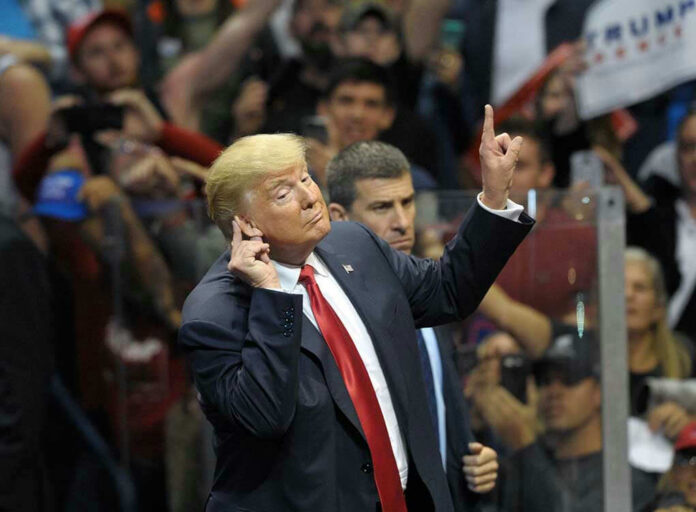
President Trump’s approval just nudged up right before the midterms, and that tiny move could matter.
Story Snapshot
- Reuters/Ipsos shows approval rising from 33% to 35% for President Trump.
- The poll ran right after the Republican midterm convention, tightening the timeline.
- Democrats still lead the generic ballot in the same survey, 44% to 37%.
- Small shifts often sit inside a margin of error near three points.
What moved and when
Reuters reports President Trump’s job approval rose to 35%, up two points from late August’s 33% low in its tracking series. The survey closed in the days after the Republican Party’s first midterm convention, placing the uptick in a clear political window.
The same poll shows Democrats ahead by seven points on the congressional preference, which frames the road the party faces in November. The story is a nudge up for Trump, not a wave.
President Donald Trump's approval rating has ticked up slightly after reaching a record low last month, according to a new poll released weeks before the midterm elections. MORE: https://t.co/2E9zwtl6I6 pic.twitter.com/qGjJ9tVVUo
— NEWSMAX (@NEWSMAX) September 15, 2026
Week-to-week movement can look like momentum. In national polling, a typical sample of around 1,000 adults carries a margin of error near three points. That means a two-point change can be noise, signal, or a bit of both.
Reuters explains its large national surveys run several thousand respondents with small margins for the full sample, while rolling trackers vary by wave. Treat a single move with care, but do not ignore it. Patterns start as single dots.
How to read a two-point rise
Numbers alone do not tell a strategy. Campaigns test whether a jump ties to a message, an event, or shifting news. The timing here follows a high-profile party convention and a period of intense coverage.
If the next waves confirm 35% or higher, that suggests a floor lifted. If it drops back, the move was a blip. Common sense says watch trend lines and averages, not only one print. Responsible voters and investors do the same.
Media often hype small changes as a surge. That temptation misses what usually drives midterms: the level of presidential approval, not small week swings. Political history links sub-50% approval to losses for the president’s party, and deeper lows to bigger losses.
That is the gravity at work. A move from 33% to 35% is better than falling, but it still sits well below comfort range for a governing party heading into a national test.
What conservatives should make of this
Conservative voters should see two truths at once. First, an uptick after a major party event suggests messages can still cut through. That is a sign to press the case on core issues—border security, prices, energy independence, crime—with clarity and receipts.
Second, the overall level remains tough. The left still holds a lead on the ballot test in this poll. Winning requires expanding beyond the base, not just exciting it. That means persuading suburban and working voters with practical plans.
APPROVAL UP FROM RECORD LOW, GOP MIDTERM OUTLOOK SOURS
Trump's approval rose from a record low in a Reuters/Ipsos poll taken after the GOP midterm convention in Dallas. But Republicans are losing their edge on the economy and trail Democrats by 7 points on the generic ballot -… pic.twitter.com/zd93AIpaZr
— Daniel J Reports (@DanielJReports) September 16, 2026
Focus on what moves the middle. Voters over 40 want stability and lower costs. Tie the agenda to paychecks, safety, and schools. Show how policies reduce prices at the pump and in the grocery aisle.
Draw a clear line from energy supply to inflation relief. Make immigration control about order and fairness. Keep the war-and-peace questions grounded in strength that avoids costly, open-ended conflicts. Approval rises when daily life gets easier and leaders look steady.
What to watch next
Watch the next two Reuters/Ipsos releases to see if 35% holds or builds. Compare them with other national trackers to smooth out house effects. Look for movement in independents and soft Republicans, not only strong supporters.
Track the generic ballot gap; narrowing there matters more than a single approval point. Expect campaigns to test fresh ads born from the convention’s themes. If those messages sustain gains, momentum becomes measurable signal rather than statistical static.
Sources:
reuters.com, cnn.com, lohud.com