
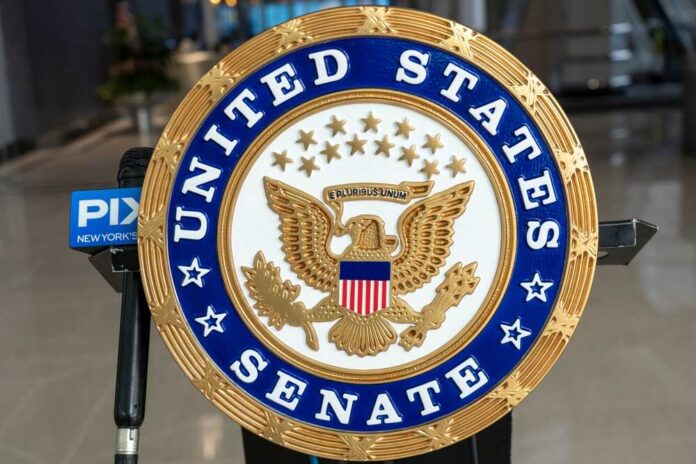
The Senate just handed President Trump control over the nation’s money supply by confirming Kevin Warsh as Federal Reserve Chairman in a razor-thin 54-45 vote that broke almost entirely along party lines.
Story Snapshot
- Senate confirmed Kevin Warsh as Fed Chairman Wednesday, replacing Jerome Powell after months of political maneuvering and a DOJ investigation obstacle
- Only one Democrat, Pennsylvania Senator John Fetterman, crossed party lines to support Warsh in the highly partisan 54-45 vote
- Powell remains on the Fed’s Board of Governors through 2028, creating an unprecedented dual-leadership dynamic at the central bank
- Warsh’s appointment signals a likely shift toward lower interest rates, aligning with Trump’s preference for more accommodative monetary policy
- The confirmation caps a turbulent transition marked by Trump’s public criticism of Powell and questions about Federal Reserve independence
A Political Victory Years in the Making
Trump finally got what he wanted. After years of publicly battling Jerome Powell over interest rates and threatening to fire him, the president successfully installed a Fed chairman more sympathetic to his economic vision.
Warsh, 54, brings prior Federal Reserve experience from his 2006-2011 stint as a governor and has signaled support for lower rates that Trump consistently demands.
The confirmation came after a month-long selection process that began in summer 2025 and was nearly derailed by a Justice Department criminal investigation into Powell over a headquarters renovation project.
Senate confirms Trump pick Warsh as chairman of the Federal Reserve, following Powell https://t.co/DO1hWHX8Gy
— The Baltimore Banner (@BaltimoreBanner) May 13, 2026
The Investigation That Almost Changed Everything
Republican Senator Thom Tillis of North Carolina held the entire confirmation process hostage until the DOJ dropped what he called a “bogus” investigation into Powell.
The standoff worked. U.S. Attorney for D.C. Jeanine Pirro closed the probe in April 2026, though she left the door open to reopen it if the Fed’s inspector general found wrongdoing.
Once that obstacle was cleared, Senate Republicans moved with remarkable speed, confirming Warsh to a 14-year term on the Board of Governors on Tuesday and elevating him to chairman the following day. The tight timeline and purely partisan support exposed just how politicized the Fed’s leadership has become.
Powell’s Unusual Decision to Stay
Jerome Powell isn’t going anywhere, at least not yet. Despite losing the chairmanship, he committed to remaining on the Board of Governors through at least 2028, pledging to “keep a low profile” as a rank-and-file member.
This arrangement creates an unprecedented situation where the outgoing chairman sits alongside his replacement, potentially creating internal friction over monetary policy direction.
Powell stated publicly that “there is only ever one chair of the Federal Reserve Board” and that Warsh will be that chair once sworn in. But his continued presence ensures institutional memory and provides a counterweight to any radical policy shifts Warsh might attempt.
What Lower Rates Really Mean
Financial markets expect Warsh to pursue more aggressive interest rate cuts than Powell’s cautious approach. That’s good news for borrowers facing high mortgage rates, credit card bills, and business loans.
Lower rates typically boost stock prices and real estate values, benefiting asset owners while punishing savers and retirees who depend on interest income.
The risk comes from cutting rates too quickly and reigniting inflation that Powell spent years fighting. Warsh inherits an economy still grappling with the impacts of the Iran war and persistent inflation concerns.
His willingness to accommodate Trump’s preference for growth over price stability will determine whether this confirmation marks a return to prosperity or the beginning of another inflation crisis.
The Independence Question Nobody Wants to Answer
Fed independence has long served as a cornerstone of American monetary policy, insulating central bankers from short-term political pressures. Warsh’s confirmation on a near-party-line vote undermines that principle.
Three Trump nominees now serve as governors alongside three Biden appointees, with Trump attempting to remove Biden-appointed Lisa Cook despite court orders blocking the effort.
This partisan composition raises legitimate concerns about whether the Fed can maintain credibility as an independent institution or whether it becomes another political weapon deployed by whoever controls the White House.
Conservative principles favor limited government and sound money, but they also recognize that monetary policy shouldn’t shift radically with every election cycle.
Senate confirms Trump pick Warsh as chairman of the Federal Reserve, following Powell https://t.co/sbXt90IXSy pic.twitter.com/A46gUjCwlz
— Eyewitness News (@ABC7NY) May 14, 2026
The Real Test Begins Friday
Warsh officially assumes the chairmanship on Friday, May 16, inheriting a Federal Reserve that steered the economy through a pandemic, fought inflation back from generational highs, and maintained financial stability during extraordinary turbulence. The question isn’t whether Warsh possesses the credentials for the job—his resume speaks for itself.
The question is whether he’ll demonstrate the independence necessary to make unpopular decisions when economic conditions demand them, or whether he’ll prioritize political alignment with the administration that appointed him.
Markets will be watching his first policy moves closely, looking for signs of whether he’ll chart his own course or simply implement Trump’s preferred monetary policy by proxy.
Sources:
Senate confirms Kevin Warsh as Fed chair as Trump’s economic vision comes into focus – Fox News
Who will run the Federal Reserve if the Senate doesn’t confirm Trump’s pick Kevin Warsh? – CBS News
Kevin Warsh confirmed by Senate to lead the Federal Reserve – CBS News