
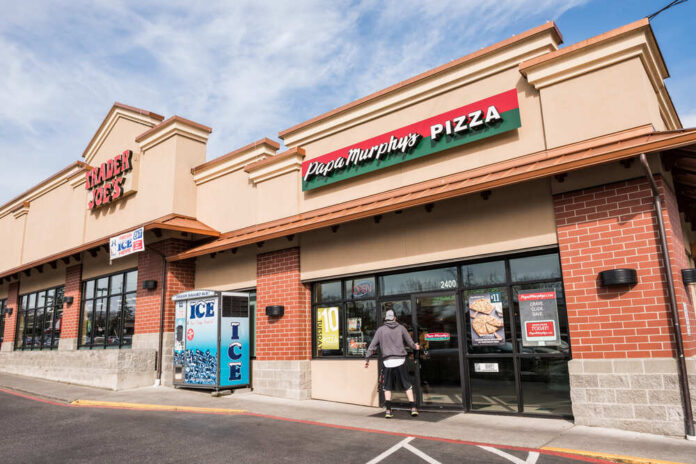
A once-booming take-and-bake pizza chain just admitted its big turnaround bet failed, and now up to 50 of its own stores are on the chopping block.
Story Snapshot
- MTY Food Group will close 68 underperforming corporate-owned restaurants, with up to 50 being Papa Murphy’s locations.
- These stores lost more than $10 million over 12 months, and their results kept getting worse.
- Papa Murphy’s corporate profit and revenue have dropped sharply since the turnaround push began.
- The closures cap a multi‑year pattern of shutdowns as the pizza chain struggles in a crowded market.
Pizza chain faces painful reset after turnaround strategy fails
MTY Food Group, the Canadian company that owns Papa Murphy’s, told investors it will close 68 underperforming corporate-owned restaurants over the next six to nine months. Up to 50 of those locations are expected to be Papa Murphy’s stores, mainly units MTY took back from franchisees in an effort to stage a turnaround. The remaining closures will come from other brands in MTY’s portfolio, but the focus and the pain are centered on Papa Murphy’s.
Papa Murphy’s to close 50 restaurants over declining sales https://t.co/VxO3U513jo
— KFOR (@kfor) July 14, 2026
Chief executive Eric Lefebvre said these 68 restaurants have lost more than $10 million over the last year, and many are still sliding in the wrong direction. He explained that the company repossessed three clusters of Papa Murphy’s locations, believing corporate ownership could improve operations and sales. That experiment did not work. MTY concluded that keeping these stores open would keep draining cash, so closing them became the least bad option in a tough environment.
Corporate takeover of franchise stores backfires
MTY bought Papa Murphy’s for about $190 million as part of a broader growth and turnaround plan, aiming to sharpen operations and revive the brand. As part of that push, MTY converted dozens of franchise-run Papa Murphy’s stores into corporate-owned units, hoping tighter control would fix weak performance. According to Lefebvre, Papa Murphy’s has been “struggling more than our other brands as of recent,” a blunt admission that the conversion strategy did not deliver.
Of the 68 stores marked for closure, MTY has said that roughly 45 to 50 are Papa Murphy’s locations that went from franchise to corporate ownership. These are precisely the units MTY believed it could run better than local owners. Instead, they became a money pit. This fits a wider pattern in the restaurant world, where large acquirers often misjudge how much value local franchisees add in day-to-day operations, staffing, and neighborhood marketing. When that local know-how disappears, sales can fall faster than any corporate plan can fix.
Sales slump, shrinking profits, and rising costs converge
The closures come against a backdrop of softer sales and squeezed profits across MTY’s brands. Same-store sales fell by 2.1 percent overall, with declines in both the United States and Canada. Corporate segment profit tied to Papa Murphy’s and similar units dropped from $11.3 million to $5.7 million, while corporate revenues fell 15 percent to $111.7 million. For a parent company built on steady franchise fees and operating margins, that kind of drop sends a clear signal that something is broken.
Lefebvre also pointed to a harsh competitive landscape in pizza. He said Papa Murphy’s is “currently suffering a little bit more” than other brands as rivals flood the market with deals, delivery options, and digital ordering. The take-and-bake model depends on busy families willing to pick up a raw pie and bake it at home. That pitch is harder to sell when third-party delivery apps make hot, ready-to-eat pizza only a few taps away, often with coupons attached. For cost-conscious, time-starved households, convenience usually wins.
Multi-year wave of closures shows deeper brand strain
The latest 45 to 50 corporate Papa Murphy’s closures are not a one-off event. MTY has already overseen a steady shrinkage of the chain. Papa Murphy’s closed 43 locations in 2023 and about 100 in 2024, most of them franchise-operated stores that simply could not earn enough to stay open. Trade coverage estimates that since early 2023, the brand has shuttered roughly 120 stores, on top of dozens more in 2022, a striking reversal for a chain that once packed suburban strip malls nationwide.
One of the largest pizza chains in the country is preparing to close up to 50 Papa Murphy’s locations as its parent company, MTY Food Group, eliminates underperforming restaurants while it works through a “challenging period” for the business. https://t.co/gxZrOff70F
— KIRO Newsradio 97.3 FM🎙 (@KIRONewsradio) July 13, 2026
From a common-sense conservative angle, MTY’s move looks like delayed discipline finally catching up with a struggling asset. Management let weak units bleed cash for too long, then tried a centralized “we’ll run it better” fix that ignored the value of local ownership. When sales stayed soft and profits cratered, the company chose to cut losses and refocus on stronger stores. That is harsh for workers and communities losing a familiar pizza shop, but it reflects a basic rule of business: capital must move to where it can earn a return.
What this means for customers and the wider restaurant industry
For loyal Papa Murphy’s customers, the near-term impact is simple and painful. Some regular stores will vanish in the coming months, especially in weaker markets. Lefebvre said the first wave of closures would begin during the week of July 13, with more shutting down over the following six to nine months. Remaining locations will likely see more pressure to boost sales, tighten costs, and prove they deserve continued investment.
For the wider restaurant world, this episode is another warning shot. Research on restaurant performance shows that franchise chains fail at almost the same rate as independent operators over time, despite the supposed safety of “big brand” backing. When debt is high, food and labor costs stay elevated, and foot traffic softens, even large chains must make sharp cuts to survive. Papa Murphy’s corporate conversion gamble shows what happens when a turnaround leans on top-down control instead of strong local operators, clear value for families, and careful unit economics.
Sources:
foxbusiness.com, investing.com, youtube.com, ground.news, marketscreener.com, scanx.trade, tradingview.com, finance.yahoo.com, chrie.org