
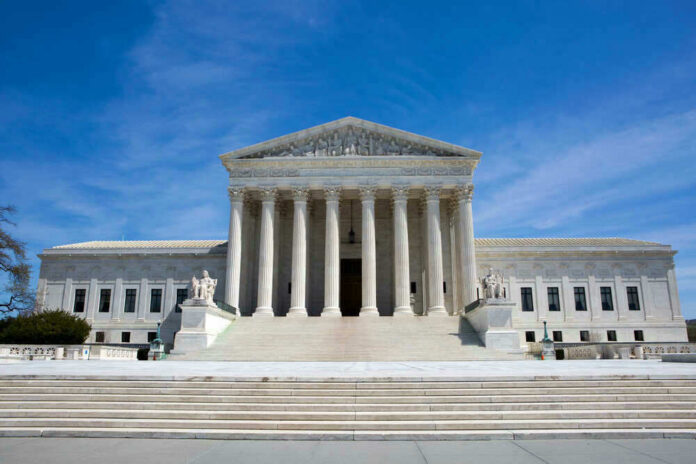
The Supreme Court just ripped up Hawaii’s “vampire rule,” handing gun owners a major win and warning other blue states that the Second Amendment still means what it says.
Story Snapshot
- Supreme Court strikes down Hawaii’s law that forced gun owners to get permission to carry in stores and hotels.
- Ruling says licensed Americans may carry on most private property open to the public unless owners clearly ban guns.
- The Court rejects Hawaii’s “spirit of Aloha” excuse and sticks to the plain text of the Second Amendment.
- Property owners still can post signs and keep guns out, but states cannot make every doorway a gun-free zone by default.
High Court Rebukes Hawaii’s ‘Vampire Rule’
The United States Supreme Court ruled 6–3 that Hawaii’s 2023 gun law, nicknamed the “vampire rule,” violates the plain text of the Second Amendment.[5] Hawaii had tried to force lawful gun owners to get express permission before carrying a firearm into nearly any private business that was open to the public, including hotels, stores, and gas stations.[3]
The Court held that ordinary citizens seeking to carry handguns for self‑defense on such property are clearly within “the people” and “bear Arms” protected by the Constitution.[6]
The decision grew out of the Wolford v. Lopez case, where concealed carry permit holders challenged Hawaii’s default ban on carrying on private property open to customers unless the owner gave prior consent.[5] Under the law, even stepping into a convenience store while armed could make a law‑abiding citizen a criminal if they had not first asked permission.[12]
The majority said that once conduct falls under the Second Amendment’s text, the burden shifts to the government to show a deep historical tradition supporting its restriction, a standard Hawaii failed to meet under the test first laid out in New York State Rifle & Pistol Association v. Bruen.[18]
What Changes For Gun Owners And Businesses
The ruling means that across Hawaii, and by extension other states with similar ideas, the default flips in favor of gun rights on most public‑facing private property.[1] Lawful gun owners may now carry firearms into shopping malls, hotels, gas stations, and other businesses open to the public unless and until the owner clearly says “no guns allowed,” such as by posting a sign at the entrance.[2]
The Court stressed that this case deals only with regular businesses open to the public, not classic “sensitive places” like schools or polling places, which remain open to tighter rules.[2]
This is sure to be a landmark Supreme Court case. After all, it’s a win for every law-abiding American who carries a firearm for self-defense. https://t.co/WPwTYBGdYT
— Rand Paul (@RandPaul) June 28, 2026
Importantly, the ruling does not strip power from property owners; it strips power from the state.[2] Hawaii businesses still have full authority to ban guns on their land if they choose, simply by giving notice to customers.[2]
The Court made clear that the Constitution stops the government from turning every doorway into a trap for lawful gun owners, but it does not force private owners to welcome firearms. That balance respects both the right to self‑defense and the long‑standing American respect for private property rights, instead of letting politicians hide behind vague “public safety” slogans.
Court Rejects ‘Spirit of Aloha’ And Ideological Gun Control
Hawaii tried to defend its law by claiming it matched the local “spirit of Aloha” and by pointing to an 1865 Louisiana statute from the Black Codes era that targeted freed slaves, arguing that both showed a tradition of requiring property owner permission before carrying.[2]
The majority refused to let regional branding or troubling Reconstruction‑era laws override the Second Amendment, noting that the right to keep and bear arms cannot give way to the “spirit of aloha” any more than to the “spirit of the Big Apple or the Windy City.”[2] That line undercuts efforts to dress up modern gun control in feel‑good language while leaning on racist historical precedents.
Gun control groups such as Everytown Law quickly labeled the ruling “flawed” and warned it would turn “any private property open to the public into a default carry zone,” hoping to sway public opinion against the Court’s reasoning.[2]
They had urged the Court to protect Hawaii’s law as “common‑sense” safety regulation, even after the Bruen decision warned states that they must prove a strong historical foundation for new limits on public carry.[18]
The 6–3 split followed the Court’s usual ideological lines, and critics claim politics drove the outcome, but the majority relied on the same text‑and‑history method it has used in several recent Second Amendment cases.[3]
Broader Battle Over Second Amendment Rights After Bruen
This case is part of a wider wave of fights after Bruen, where states like New York, New Jersey, Maryland, California, and Hawaii have tried to rebuild gun restrictions under new names and categories.[18] Many of these laws stretch the idea of “sensitive places” to cover ordinary spaces like restaurants, parks, and stores, effectively gutting carry permits by making almost everywhere off‑limits.[2]
Federal courts have already struck down a growing list of these post‑Bruen laws for lacking clear founding‑era analogues, and Wolford v. Lopez continues that trend by rejecting Hawaii’s attempt to rebrand almost all private property as presumptively gun‑free.[18]
Supreme Court strikes down Hawaii law requiring permission to carry guns in stores.
The ruling allows licensed gun owners to carry firearms into businesses unless owners clearly prohibit them.
The court ruled the law violated the Second Amendment.
Source: NewsForce
Host:… pic.twitter.com/uL67uxJT91— NewsForce (@Newsforce) June 27, 2026
For gun owners and constitutional conservatives, the ruling is a clear reminder that the Second Amendment is not a second‑class right to be brushed aside whenever a state government claims a new emergency.[21] It also signals to legislatures in deep‑blue states that creative wording like “vampire rule” or appeals to local “spirit” cannot hide simple hostility to lawful carry.
At the same time, the Court left open space for genuine sensitive‑place rules and for property owners to choose their own policies, keeping the focus where it belongs: stopping government overreach, not micromanaging every private choice.
Sources:
[1] Web – Supreme Court strikes down Hawaii law requiring permission to carry …
[2] Web – Wolford v. Lopez – Oyez
[3] Web – 6–3 Second Amendment SCOTUS Decision in Wolford v. Lopez …
[5] Web – WOLFORD V. LOPEZ, No. 23-16164 (9th Cir. 2024) – Justia Law
[6] Web – [PDF] 24-1046 Wolford v. Lopez (06/25/2026) – Supreme Court
[12] Web – Supreme Court skeptical of Hawaii’s ‘vampire rule’ for gun owners
[18] Web – Permission to enter, with a gun? Justices look to defang Hawaii’s …
[21] Web – [PDF] The Second Amendment and States’ Rights: A Thought Experiment