
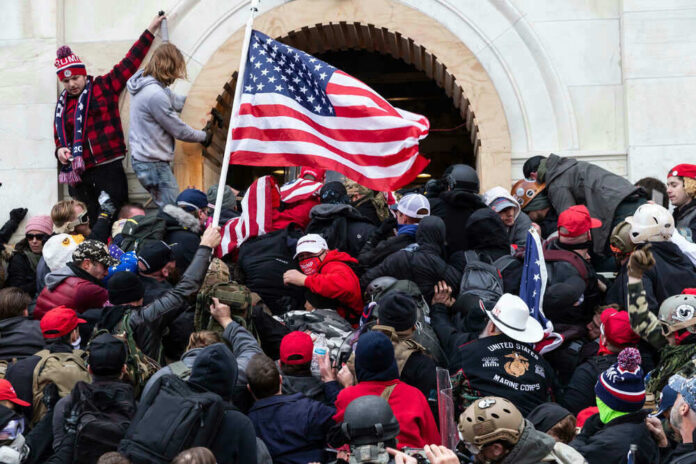
Four years after pipe bombs threatened both Republican and Democrat party headquarters on the eve of January 6, the FBI still has no suspect and released new video footage of the suspect today in the hope that someone will recognize the suspect.
See the video released today by the FBI’s Washington Field Office further down our report.
Story Snapshot
- FBI releases new, higher-quality surveillance footage of the 2021 D.C. pipe bomb suspect, but the case remains unsolved despite nearly four years of investigation.
- The bombs were viable and placed just before the Capitol riot, targeting both major party headquarters and exposing vulnerabilities in national security.
- Extensive resources, including a $500,000 reward and joint agency efforts, have failed to produce an arrest or even a public identification of the suspect.
- Ongoing congressional oversight and public scrutiny highlight concerns about investigative gaps, law enforcement coordination, and the unresolved threat to U.S. political institutions.
FBI Renews Public Appeal Amid Ongoing Uncertainty
The Federal Bureau of Investigation renewed its call for public assistance after releasing new high-definition surveillance videos depicting a suspect calmly planting pipe bombs near both Democrat and Republican National Committee headquarters in the heart of Washington, D.C.
The new footage, made public almost four years after the original incident, underscores the continuing struggle of federal law enforcement to solve a case that threatened American democracy at a moment of peak political division.
Despite a sustained $500,000 reward and the deployment of every investigative tool available, the perpetrator remains at large, raising critical questions about the effectiveness and transparency of the agencies entrusted with our safety.
The FBI is still offering a $500,000 reward for information that helps identify the person who placed pipe bombs at the offices of the Democratic National Committee and Republican National Committee on January 5, 2021. As part of our ongoing investigation, we're releasing an… pic.twitter.com/LAP36S1nIk
— FBI Washington Field (@FBIWFO) October 22, 2025
On January 5, 2021, between 7:30 and 8:30 p.m., the unidentified suspect was captured on multiple surveillance cameras as they moved through residential and commercial areas, ultimately placing viable explosive devices outside both the DNC and RNC headquarters.
The following day, as the nation’s attention turned to the unfolding chaos at the Capitol, law enforcement safely neutralized the bombs, averting what could have been mass casualties or further unrest.
The precise timing and location of the devices—mere blocks from the U.S. Capitol during an unprecedented riot—raise concerns about intent and possible coordination, questions that have only deepened as time drags on without resolution.
Investigative Challenges and Congressional Oversight
Law enforcement agencies, including the FBI, ATF, D.C. Metropolitan Police, and U.S. Capitol Police, launched a joint investigation immediately after the discovery. Tactics ranged from the review of hours of video footage, geofence warrants, and cell tower data analysis to forensic examination of device components.
Despite this, the suspect’s identity remains unknown, and the FBI’s appeals have become increasingly urgent.
Congressional subcommittees have held hearings and released reports examining both the scope and shortcomings of the investigation, as well as the adequacy of law enforcement preparedness in the face of potential domestic terrorism.
While several persons of interest have been identified, no arrests or public breakthroughs have emerged, fostering frustration and skepticism among Americans who expect results from institutions funded to protect them.
Security experts note that the sophistication of the devices and the suspect’s apparent ability to evade identification despite extensive surveillance pose significant challenges to law enforcement.
Some analysts argue that investigating crimes in dense urban environments can be hampered by limited actionable evidence, even with high camera coverage.
Congressional oversight continues to scrutinize investigative progress, emphasizing the need for accountability and transparency in cases with such far-reaching implications for national security.
FBI releases new videos of 2021 D.C. pipe bomb suspect, as case remains unsolved – CBS News https://t.co/cgAa7uiRmf via @GoogleNews
— TheUrbanNewz (@TheUrbanNewz) October 23, 2025
Broader Implications for Safety, Security, and Trust
The ongoing failure to resolve this case has heightened public anxiety, particularly among those who see it as emblematic of broader threats to American political institutions and a warning about the limits of government protection in a turbulent era.
Political party staff, Capitol Hill residents, and the broader D.C. community remain affected by the unresolved threat, while the federal government faces mounting pressure to improve coordination and effectiveness.
Increased security measures for political facilities and events have driven up costs and introduced further scrutiny of government spending and priorities, especially in an age when American families already feel the pinch of inflation and government overreach.
Community members—especially those who remember the violence and chaos of January 6—are left wondering whether justice will ever be served, and whether the agencies responsible for national security can be trusted to deliver real results.
FBI releases new videos of 2021 D.C. pipe bomb suspect, as case remains unsolved. https://t.co/HsuDxMJtIr
— ELLIOT IN THE MORNING (@EITMonline) October 23, 2025
Expert commentary reinforces that the attack’s symbolic timing and the suspect’s ability to evade capture remain deeply troubling. Some question whether the bombs were meant as a diversion or a failed attack, while others debate the adequacy of law enforcement’s response and the transparency of information released to the public.
Congressional reports and FBI statements remain the most credible sources for factual updates, but the lack of closure continues to cast a shadow over the effectiveness of federal investigative agencies and the safety of our nation’s political infrastructure.
Sources:
FBI: $500,000 Reward Remains in Effect for Information About Capitol Hill Pipe Bomber
Chairs Loudermilk, Massie Release January 6, 2021 Pipe Bomb Report
FBI Video: January 5 Pipe Bomb Investigation—New Footage of Suspect Placing Bomb at DNC
FBI Video: WFO Pipe Bomb October 2025 Update