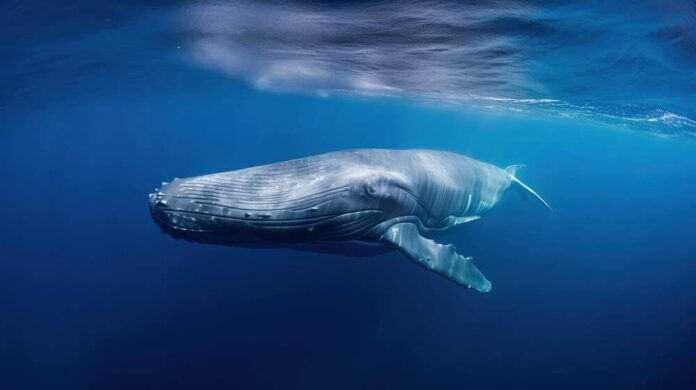
A remarkable 1949 whale recording, lost for decades in a Massachusetts archive and mislabeled as “fish noises,” has emerged as a powerful scientific tool that could expose just how drastically human industrial activity has polluted our oceans and disrupted marine life.
See the video with audio below.
Story Snapshot
- Woods Hole Oceanographic Institution archivist discovered the oldest known whale recording on forgotten 1949 plastic discs labeled “fish noises”
- The humpback whale song captured near Bermuda predates the famous 1970s whale recordings by more than two decades
- Recording provides rare baseline data from before the massive post-war expansion of shipping and industrial ocean noise
- Scientists plan to use the 77-year-old audio to measure how human activity has changed ocean soundscapes and whale communication
Forgotten Archive Yields Scientific Treasure
Ashley Jester, Director of Research Data and Library Services at Woods Hole Oceanographic Institution, discovered unusual Gray Audograph plastic discs during a 2025 archive tour.
The discs, etched with sound grooves like miniature records and labeled only as “fish noises,” sat forgotten for decades.
When digitized with a $10,000 National Recording Preservation Foundation grant, marine bioacousticians identified the unmistakable pitch and pattern of humpback whale song recorded March 7, 1949, near Bermuda aboard the research vessel R/V Atlantis. WHOI formally announced in February 2026 that this represents the oldest known preserved whale recording.
Researchers say the discovery of the oldest known recordings of whale sounds could open up a new understanding of how the huge animals communicate. pic.twitter.com/eqS7Z5Vv24
— The Associated Press (@AP) March 16, 2026
Naval Research Accidentally Captures Marine Mystery
The 1949 scientists were working with the U.S. Office of Naval Research, testing sonar systems and measuring underwater explosive acoustics, not studying marine mammals.
They lowered a crude hydrophone while conducting experiments and captured unfamiliar sounds on a Gray Audograph dictation machine—office equipment adapted for field use.
The researchers had no idea they were recording a whale; marine mammal bioacoustics was barely a field. This accidental capture occurred the same year WHOI scientists William Schevill and Barbara Lawrence made the first confirmed wild marine mammal recording of beluga whales in Canada’s Saguenay River.
Oldest known whale recording could unlock mysteries of the ocean https://t.co/BTZwuBcQCl
— CTV News (@CTVNews) March 16, 2026
Baseline Data Exposes Human Ocean Impact
Laela Sayigh, senior research specialist in marine mammal bioacoustics at WHOI, emphasized that data from this period “simply don’t exist in most cases.”
The recording captures the ocean soundscape before the massive post-World War II expansion of global shipping, offshore drilling, naval exercises, and industrial construction, which flooded marine environments with low-frequency noise that overlapped with whale communication frequencies.
Scientists can now compare this 1949 baseline with Ocean Alliance’s archive of more than 2,400 whale recordings from the 1950s through 1990s and with modern acoustic monitoring to quantify exactly how much human activity has degraded ocean acoustic habitats critical to whale survival.
Conservation Tool Highlights Regulatory Failures
Peter Tyack, a marine bioacoustician and emeritus research scholar at WHOI, stated that underwater recordings are powerful tools for understanding and protecting vulnerable whale populations when visual observations fail.
The recordings reveal how shipping and industrial sounds alter the ocean soundscape and affect whale communication, navigation, feeding, and stress levels.
This discovery underscores the value of long-term data preservation and highlights decades of regulatory failure to protect marine acoustic environments from industrial pollution.
WHOI continues digitizing its Audograph collection, with potential for additional early ocean sound discoveries that could further document the baseline conditions before human activity fundamentally changed marine ecosystems.
Sources:
WHOI discovers the oldest known whale recordings, dating to 1949
Oldest whale song recording discovered
Oldest whale song humpback recordings discovered at WHOI
Listen to the Oldest Known Whale Recording