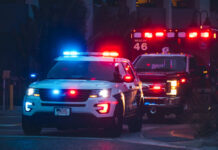


Three people lay dead, a police officer survived multiple gunshot wounds, and a suspect surrendered after hours—yet the most urgent question still hangs in the air: what exactly turned a domestic call into a deadly siege? [3]
Story Snapshot
- Police say officers exchanged gunfire with a suspect after responding to a domestic disturbance in Sandy, Oregon. [3]
- At least three people were reported dead; officials called the scene “traumatic.” [1][2]
- A Sandy police officer was shot multiple times and is expected to survive. [3][4]
- A suspect surrendered and was taken into custody; charges include murder and kidnapping, pending arraignment. [1]
What Police Say Happened, Minute by Minute
Police described a volatile chain of events that began with a domestic disturbance call on Evans Street shortly before 4 p.m. Officers and deputies reported taking fire upon arrival and returning fire, triggering a shelter-in-place order across a residential pocket of Sandy.
The standoff stretched for hours until just before 8 p.m., when the suspect surrendered. Officials emphasized that investigators were still processing a complex scene and interviewing witnesses late into the night. [3][1]
Multiple people are dead and one officer is wounded after a shooting outside of Portland, Oregon, on Sunday, police said. https://t.co/FnT9gPjM6F
— CBS News (@CBSNews) June 1, 2026
Officials confirmed multiple fatalities at the scene, with Oregon Public Broadcasting reporting at least three people dead as the immediate crisis ended.
The police chief framed the response as an “active and dynamic investigation,” a caution that the casualty count and relationships would be clarified by forensic work and notifications. That measured language matters; early numbers often wobble as medical examiners, detectives, and next-of-kin processes move from chaos to confirmation. [1][3]
The Wounded Officer And The Gunfire Exchange
The Sandy officer struck by multiple rounds was hospitalized in stable condition and expected to survive, according to briefings carried by local broadcasters and follow-up reporting.
Police underscored that officers exchanged gunfire with the suspect, placing law enforcement inside a deadly domestic dispute that had already turned lethal before the wider response converged. The details offered so far stop short of a complete shot-by-shot reconstruction, which typically depends on ballistics and video review. [4][3][1]
The surrender capped hours of uncertainty. Journalists on scene relayed that the suspect gave up without additional shots, which reduced the risk of further casualties and allowed investigators to secure evidence without breaching under fire.
The custody phase also opened the door to formal allegations. Jail records reviewed by reporters showed bookings on three counts of murder and two counts of kidnapping, among other offenses, with the caveat that charges can evolve at arraignment. [1]
Domestic Violence Frame, And Its Limits So Far
Local leaders and police publicly cast the event as domestic violence, a framing that aligns with the initial 911 call and the location inside a residential neighborhood. That early lens helps residents understand the risk profile: targeted interpersonal violence rather than a random public rampage.
Yet the case file released to date has not detailed motive, victim identities, or precise relationships to the suspect. Those specifics usually surface through charging documents and medical examiner reports, not first-night briefings. [3][1][2]
Scrutiny should welcome two parallel truths. First, the police version covers the basics—who, what, where, and custody—supported by on-camera statements and contemporaneous reporting. Second, motive and sequence require hard proof, not inference.
Sound policing values facts over narrative momentum: shell casings matched to a weapon, autopsy timings, dispatch logs, and body camera footage are the safeguards against rumor and the foundation for accountability, whether for the suspect or for official decisions made under fire. [3][1]
What To Watch As The Case Advances
Expect the district attorney’s charging documents or probable-cause affidavit to fill in the scene chronology: first shots fired, locations of victims, and whether the suspect’s rounds account for each death.
Ballistic analysis should tie weapons to wounds and reveal firing angles that explain how an officer absorbed multiple hits yet survived. Body camera footage and radio traffic will anchor a second-by-second narrative about officer approach, return fire, and the surrender that ended the siege. [1][3]
Multiple people are dead, and a police officer is recovering after a domestic violence shooting led to a tense standoff in Sandy, Oregon, on Sunday. https://t.co/ydPWhQk1XV
— NewsRadio WHAM 1180 (@WHAM1180) June 2, 2026
Readers should also weigh the media dynamic that followed the press conference. Local and national outlets repeated the same official lines with slight variations, a common pattern that can harden public certainty before forensics are public.
That does not undercut the core facts already on the record; it simply argues for patience. The same discipline that keeps officers safe—clear commands, verified information, measured escalation—should guide the public’s understanding until the evidence file, not the echo chamber, settles the why. [1][2][3]
Sources:
[1] Web – Mass shooting in Oregon leaves several dead, officer wounded; suspect …
[2] Web – Multiple dead, officer wounded in Sandy shooting Sunday evening
[3] Web – Multiple killed and officer shot in Sandy after domestic disturbance
[4] Web – Sandy Hook Elementary School shooting – Wikipedia