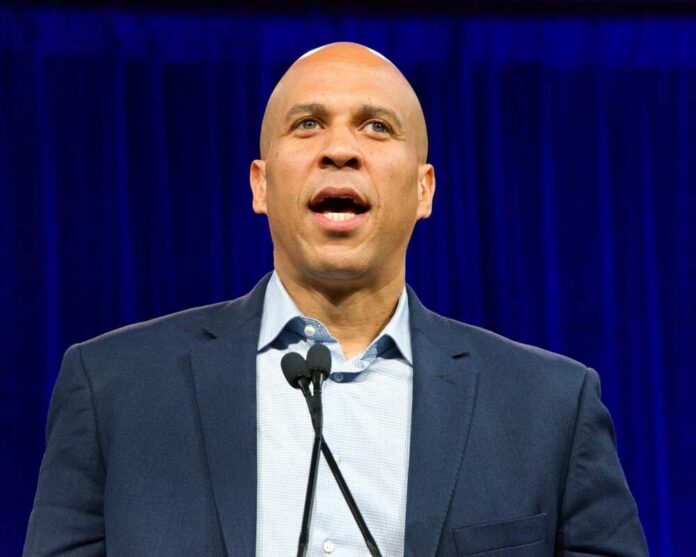
Cory Booker is already testing the 2028 waters—while Americans are consumed with war abroad and a divided electorate at home.
Story Snapshot
- Sen. Cory Booker told Fox News in New Hampshire that he’s “thinking about” a 2028 presidential run and hasn’t ruled it out.
- Booker is simultaneously facing a 2026 Senate re-election, creating a two-track political strategy: national buzz now, survival at home first.
- Democrats have no clear 2028 frontrunner, pushing would-be candidates to start early in states like New Hampshire.
- Strategists cited in reporting say old “I’m not running” coyness is fading as voters demand bluntness and visibility.
Booker’s New Hampshire Stop Signals Early 2028 Positioning
Sen. Cory Booker, a New Jersey Democrat, said he is considering a run for president in 2028 during a November 2025 visit to New Hampshire, a key early-primary state.
In comments to Fox News, Booker said, “Of course I’m thinking about it. I haven’t ruled it out,” while also stressing that his immediate focus remains his 2026 Senate re-election campaign. The message was simple: he’s not declaring, but he’s not hiding either.
The Hill: Sen. Cory Booker (D-N.J.) on Sunday did not rule out running for president in 2028, the next chance Democrats have to take the White House.
Booker: “I am definitely not ruling it out. I’m running for reelection. I hope New Jersey will support me for another six years.…
— Politics & Poll Tracker 📡 (@PollTracker2024) March 29, 2026
That combination—public presidential curiosity paired with a local re-election pledge—reflects how modern campaigns are built. Potential candidates try to accumulate national donor attention, media oxygen, and activist energy long before filing paperwork.
Booker’s stop in New Hampshire matters because it’s where hopefuls audition, build relationships, and prove they can work a room. Even without a formal launch, showing up can be the first step in a long, expensive, and highly public tryout.
Why Democrats Are Starting So Early: No Incumbent, No Clear Heir
Democrats are confronting a wide-open 2028 map, and the reporting describes a party with multiple potential contenders but no obvious leader. Booker’s statement lands in that vacuum.
The context is unusual: President Donald Trump won a non-consecutive second term in 2024 but cannot run again in 2028 under the 22nd Amendment, meaning the next presidential cycle is already shaping up as a true contest on both sides.
Other Democrats have been signaling interest as well, including governors and senators who are timing decisions around the midterms. The reporting highlights how early-state travel and cautious language are being replaced by more direct admissions that politicians are “considering” a run.
From a practical standpoint, this is about relevance: in a crowded field, candidates who wait risk being forgotten. In a party that’s still sorting itself out, visibility becomes a form of leverage.
The “Authenticity” Pitch Meets Voter Fatigue With Political Theater
Coverage of Booker’s move frames it as a shift away from the traditional politician’s dodge, where candidates deny ambition until the last possible second. Strategists cited in the reporting argue that voters increasingly punish evasiveness and reward bluntness, even if it’s not a full commitment.
Booker’s willingness to say he’s thinking about 2028 fits that theory, and it also matches his recent effort to raise his national profile through high-visibility moments on Capitol Hill.
Still, authenticity is not the same as accountability. Conservative-leaning voters watching this from the outside are likely to judge Booker less by how candid he sounds and more by what policies he would push if he gained power.
The frustration many Americans feel in 2026—high costs, global instability, and skepticism of political elites—creates a tougher environment for performative politics. The reporting supports that the Democrat primary could stretch into a prolonged fight, which often produces more slogans than solutions.
Booker’s 2026 Senate Race Complicates Any 2028 Ambitions
Booker’s immediate political reality is that he must win re-election to the Senate in 2026 while keeping his presidential options open.
That balancing act can force careful messaging: he needs New Jersey voters to believe he’s committed to their concerns, while also staying visible enough nationally to remain a plausible 2028 option. The reporting notes this tension directly, describing a strategy of building profile without making a formal presidential announcement.
For conservatives focused on constitutional limits and the direction of national governance, the bigger takeaway is structural: the Democrat bench is maneuvering early because the party lacks a settled successor.
That reality can intensify ideological fights inside the left—between activists demanding confrontation and pragmatists demanding electability. If Democrats spend the next two years auditioning for anti-Trump headlines instead of offering concrete answers on inflation, borders, and energy, the general-election terrain becomes clearer.
The Ego of this guy. Mr. Spartacus Drama.
Booker ‘not ruling out’ 2028 presidential bid https://t.co/qc6GozDzn2
— Bo Snerdley (@BoSnerdley) March 29, 2026
Booker’s comments should be read as an opening bid, not a decision. The reporting indicates no formal campaign and no final commitment, only a public acknowledgment that he is thinking about it.
In a cycle already influenced by early-state travel, strategist chatter, and donor calculations, that may be enough to keep his name in the conversation. Whether it translates into a serious run will depend on his 2026 outcome and whether Democrats rally around someone else first.
Sources:
Booker ‘not ruling out’ 2028 presidential bid (Fox News video)
2028 United States presidential election (Wikipedia)
Cory Booker, Josh Shapiro among those speculated as presidential candidates in 2028 election (WHYY)