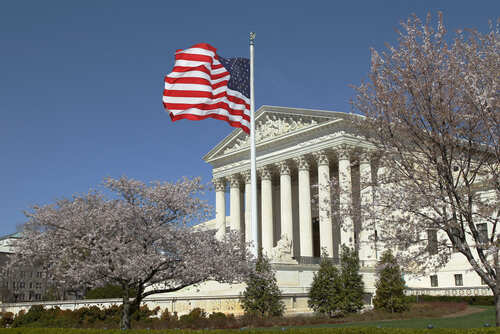
The Supreme Court just quietly drew a hard line around President Donald Trump’s conduct—and what it really means when a jury says a powerful man “sexually abused” a woman.
Story Snapshot
- A federal jury found Trump liable for sexually abusing and defaming E. Jean Carroll, awarding $5 million.
- Judge Kaplan ruled Carroll’s description of rape was “substantially true” under the common meaning of the word.
- The Second Circuit upheld the verdict and the handling of controversial evidence, including other accusers and the Access Hollywood tape.
- The Supreme Court refused to hear Trump’s appeal, making this judgment final and locking in the legal record.
How One Civil Case Turned Into A Final Judgment On Trump’s Conduct
A New York federal jury in 2023 heard E. Jean Carroll describe a 1996 encounter with Donald Trump in a Bergdorf Goodman dressing room. She said Trump pinned her, forced kisses, and then inserted his fingers into her vagina without consent.
The jury did not find “rape” under New York’s narrow criminal code definition, but did find Trump liable for sexual abuse and forcible touching and for defaming her in an October 2022 social media post denying her claims. They awarded her $5 million in damages.[1][3][7]
Judge Lewis Kaplan later explained that, based on the jury’s findings, Trump’s actions still met the common-sense meaning of rape. In a written order, he stated Carroll’s accusation of rape was “substantially true” as most people understand that word, even if the state’s statute focuses on penile penetration.
The trial record shows the jury accepted that Trump deliberately and forcibly penetrated Carroll with his fingers, causing both physical and emotional harm. This detail matters, because it defines the legal weight of what the jury actually found.[3][4][7]
Why Higher Courts Backed The Verdict Instead Of Trump’s Defense
Trump’s legal team pushed hard to undo the verdict. They said Judge Kaplan wrongly allowed testimony from two other women who claimed Trump assaulted them and allowed the 2005 Access Hollywood recording where Trump bragged about grabbing women without consent.
On appeal, the United States Court of Appeals for the Second Circuit reviewed those choices and said they fell within the rules allowing evidence of other sexual assaults to show pattern and intent. The court held that any possible error did not hurt Trump’s basic rights and kept the full $5 million judgment in place.[3][8]
President Donald Trump said he will continue fighting what he called a fake case after the Supreme Court declined to hear his appeal of a $5 million civil judgment in favor of writer E. Jean Carroll. https://t.co/rQYRblYY1y
— NEWSMAX (@NEWSMAX) June 29, 2026
Trump then went to the Supreme Court and asked the justices to step in. His brief argued that the trial was unfair and that the judge’s framing and the extra testimony turned the case into a political attack rather than a neutral trial. On June 29, 2026, the Supreme Court declined to hear the case.
That single move did not add new reasoning, but it did something more powerful: it made the jury’s verdict, the district court’s findings, and the Second Circuit’s opinion the final word in American law on this dispute.[2][3][6][8]
What The Final Ruling Says About Power, Defamation, And Common Sense
The jury’s finding was not just about the assault. They also decided Trump defamed Carroll when he publicly called her story a hoax in his October 2022 post. Because Trump is a public figure, Carroll had to show he acted with “actual malice,” meaning he either knew his denial was false or recklessly ignored whether it was true.
The jury said she met that high standard and awarded defamation damages as part of the $5 million total. For a sitting or former president, that is a rare and serious legal label.[1][3][15][16][17]
From a common-sense view, some parts of this case make people uneasy. There was no physical evidence or police report from 1996. Trump did not testify at the trial, so jurors never saw him answer questions under oath.
Many observers worry that admitting other accusers and the Access Hollywood tape risks turning “character” evidence into proof of a specific act. Yet multiple courts looked at those concerns and still said the legal rules were followed and the verdict was sound.[1][3][7][8]
Why This Case Will Shape Future Fights Over Speech And Accountability
This case sits inside a bigger battle over defamation and powerful people. Public figure cases now often decide whether speech is protected opinion or costly falsehood. Carroll’s win shows that even a famous politician can be held liable when a jury believes a detailed account of assault and decides his public denials cross the line into knowing lies.
At the same time, the narrow “not rape under New York law” finding shows how criminal codes and everyday language can clash, leaving room for spin on both sides.[1][3][4][14][18][21]
For Trump, the Supreme Court’s refusal to step in ends his options on this $5 million case. He still fights a separate $83.3 million defamation judgment from a later trial, but this earlier verdict now stands as a fixed point in his public record.
For voters and citizens, the core takeaway is simple: three levels of courts examined the evidence and arguments and left in place a jury’s decision that a man who became president sexually abused a woman and then lied about it in a way the law calls defamation.[2][3][6][9][10][14]
Sources:
[1] Web – Supreme Court rejects Trump’s push to toss $5 million verdict in E. …
[2] Web – Jury finds Trump liable for sexual abuse, awards accuser $5M
[3] Web – Supreme Court Lets $5 Million Sex Abuse Verdict Against Trump …
[4] Web – E. Jean Carroll v. Donald J. Trump – Wikipedia
[6] Web – CARROLL v. TRUMP (2023) – FindLaw Caselaw
[7] YouTube – Supreme Court Rejects Trump Appeal in E. Jean Carroll …
[8] Web – Carroll v. Trump, No. 23-793 (2d Cir. 2024) – Justia Law
[9] YouTube – Supreme Court rejects Trump’s appeal of E. Jean Carroll …
[10] Web – RAINN’s National Sexual Assault Hotline
[14] Web – The Supreme Court declined to hear President Donald Trump’s …
[15] Web – Defamation – First Amendment Watch
[16] Web – Public Officials in Defamation Legal Claims – Justia
[17] Web – Defamation of a Public Figure vs. Private Figure
[18] Web – Public Figures and Officials | The First Amendment Encyclopedia
[21] Web – Defamation Law for Public Figures and Politicians – Facebook