
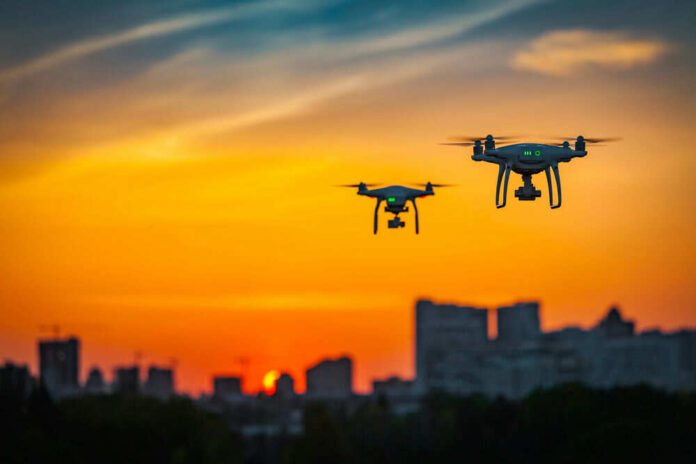
Raising urgent questions about safety, liberty, and the role of technology in American education, Florida’s plan to deploy armed drones in schools marks a bold new front in the battle to secure classrooms.
Story Snapshot
- Florida will pilot drones armed with non-lethal pepper spray in three school districts starting fall 2025.
- The initiative follows years of tragic school shootings and is funded with over half a million dollars in state support.
- Drones are remotely operated, provide real-time intelligence, and can respond to threats within seconds.
- Experts and parents are divided over drone effectiveness, privacy, and the broader implications for school environments.
Florida’s Armed Drone School Security Pilot: How It Works
In response to years of horrific school shootings and the failure of conventional policies to keep children safe, Florida is launching a first-in-the-nation pilot of armed drones designed to neutralize active shooters. Beginning in fall 2025, three districts—expected to include Miami-Dade County Public Schools—will store non-lethal drone units on campus.
Upon activation by a local official, certified pilots in Texas remotely control the drones, which are equipped with pepper spray pellets, glass-breaking tools, and advanced cameras.
These drones can reach any location on campus in under 15 seconds, providing law enforcement with real-time video and two-way communication to help manage threats swiftly and decisively.
The $557,000 state-funded program is being rolled out after successful demonstrations in Miami-Dade’s AcadeMir Preparatory High School and John A. Ferguson Senior High School. Each drone box contains six units and costs $15,000, with recurring operational expenses of $1,000 per month per 500 students.
The system was developed by Campus Guardian Angel, a Texas-based company determined to fill security gaps exposed by tragedies like Parkland.
CEO Justin Marston emphasizes the urgency, noting that “most of the death happens in the first 120 seconds,” underscoring the need for rapid, technology-enabled intervention that traditional school resource officers often cannot provide.
Background: From Parkland to Drones—A Shift in School Security Tactics
Florida’s embrace of armed drones reflects both a technological evolution and a political will to try new solutions after decades of ineffective “woke” policies and bureaucratic foot-dragging.
Since the 2018 Parkland massacre, where systemic failures contributed to devastating loss, state leaders have poured resources into school safety, including hardened facilities, new police protocols, and now, advanced drone technology.
This pilot is unique—not only for its scale but because it combines local authority with remote technical expertise, keeping control in American hands rather than relying on distant federal bureaucrats or foreign contractors.
The drones are designed to support law enforcement directly, not replace them, and their non-lethal approach addresses concerns about excessive force while prioritizing rapid response.
Florida’s move comes as other states, including Texas, Colorado, and Utah, have experimented with similar drone deployments, but none have committed as much funding or political support.
The state’s willingness to innovate—especially after years of frustration with federal overreach and failed leftist policies—positions it as a national leader in school security.
However, the pilot’s full success will depend on ongoing cooperation between districts, law enforcement, and state officials, as well as careful management of privacy and civil liberties concerns.
Debate: Safety, Liberty, and the Limits of “Security Theater”
Supporters argue that armed drones provide a critical time advantage, potentially saving lives by deterring—or disabling—would-be shooters before police can arrive. For parents and educators exhausted by years of senseless violence and government inaction, the promise of fast, decisive protection is compelling.
Yet security experts and civil liberties advocates caution that such technology may offer the illusion of safety without addressing the root causes of violence.
Critics warn about the psychological impact of militarized school environments and raise alarms over potential privacy intrusions, noting that drones with cameras could be misused if not properly regulated.
Industry analysts highlight the technology’s strengths in intelligence-gathering and deterrence, but stress that tech alone cannot replace common-sense discipline, strong family values, and community vigilance.
Most school incidents, experts note, actually involve fights or knives—not guns—raising questions about the best allocation of limited security resources.
Others worry that normalizing high-security measures may desensitize children to surveillance and government power, a genuine concern given today’s climate of government overreach.
Still, proponents point out that Florida’s approach keeps authority local and operational decisions transparent, a marked contrast to previous federalized, top-down mandates.
Armed drones designed to neutralize school shooters in seconds are being tested in several Florida districts https://t.co/8AcLo205Qr pic.twitter.com/6cmRuY03XN
— New York Post (@nypost) August 25, 2025
Ultimately, Florida’s drone pilot will be closely watched nationwide. If successful, it could become a model for other states seeking real solutions to the threat of school shootings—without sacrificing the constitutional freedoms and traditional values that define American education.
If it stumbles, it may fuel calls for a return to more grounded, community-driven security approaches. For now, parents, teachers, and officials alike are anxiously awaiting the results, hoping technology can finally deliver the peace of mind that bureaucratic promises and failed policies never did.
Sources:
Florida schools will test armed drones this fall to thwart shooters
Technologies designed to prevent school shootings create ‘security theater,’ advocate says
Armed Drones to Be Deployed at Schools to Stop Mass Shooters