Florida plans to execute a 77-year-old man on Tuesday for beating a Polk County woman to death with a hammer more than three decades ago.
Quick Take
- Curtis Beasley, 77, was convicted of first-degree murder, robbery and grand theft auto in the 1995 killing of Carolyn Monfort.
- Governor Ron DeSantis signed Beasley’s death warrant on August 26, 2026, setting the execution for September 29 at 6 p.m.
- The Florida Supreme Court rejected Beasley’s final state appeal on September 22 and denied a stay, ordering an immediate mandate.
- Beasley’s case is part of a record-breaking year for Florida executions, which now account for a huge share of the nation’s total.
What Happened To Carolyn Monfort In 1995
Carolyn Monfort was killed in August 1995 in Polk County, Florida. Court records and news reports describe her death as a hammer beating carried out during a robbery.
Beasley was later convicted of first-degree murder, robbery, and grand theft auto for the killing. The offense description has stayed consistent across years of appellate filings and news coverage of the case.
A 77-year-old Florida man convicted of the hammer beating death of a woman is set to become the 16th person executed this year in the nation’s busiest death chamber.https://t.co/8XVg25HVc5
— ABC News (@ABC) September 29, 2026
The Death Warrant And Final Court Rulings
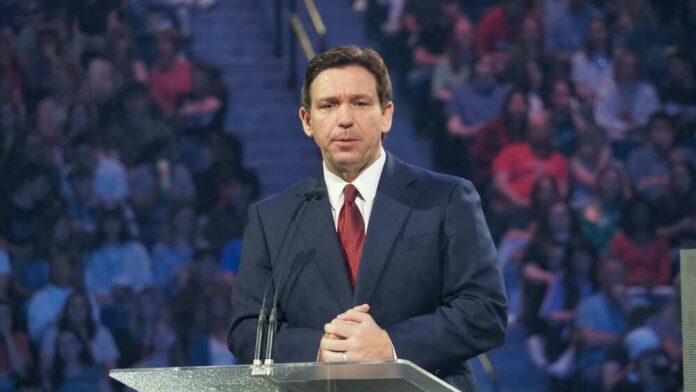
Governor DeSantis signed Beasley’s death warrant on August 26, 2026, scheduling his execution for September 29 at Florida State Prison in Starke.
The Florida Supreme Court reviewed Beasley’s final state appeal and issued its ruling on September 22, 2026, under case number SC2026-1399.
The court affirmed the denial of postconviction relief and refused to stay the execution. Its order said the mandate would issue right away, with no rehearing allowed.
That fast timeline left little room for further state-level challenges. Beasley’s attorneys had raised claims about his age and cognitive decline, arguing that executing a man his age with reported memory and health problems amounts to cruel and unusual punishment.
The Florida Supreme Court has previously rejected similar age and health-based arguments in other death penalty cases, and it did so again here.
Beasley’s Case Fits A Larger Florida Pattern
Beasley’s execution would be Florida’s 16th of 2026, continuing a pace that has made the state the clear national leader in carrying out death sentences.
Florida accounted for roughly 40% of all U.S. executions in 2025, and Governor DeSantis has signed death warrants far faster than any other sitting governor in the country. Nationally, executions have slowed elsewhere even as Florida’s numbers have climbed.
DeSantis signed 19 death warrants in 2025 alone, a state record, and has continued at a similar clip through 2026. Supporters of the pace argue it finally delivers justice to victims’ families who have waited decades.
Critics call it an unprecedented acceleration. Either way, Beasley’s case is now one entry in a much longer list, standing alongside inmates in their sixties and seventies whose sentences dated back to the 1990s.
Emergency Appeals And What Comes Next
With Florida’s highest court finished with the case, Beasley’s legal team has turned to the United States Supreme Court in a last-round emergency filing.
Such filings are common in the closing days before a scheduled execution and rarely change the outcome, though they can draw significant attention right up to the moment of the lethal injection. Barring intervention from the nation’s highest court, the execution is set to proceed as scheduled at Florida State Prison.
It is worth noting that an execution date, once set by a signed warrant and upheld through appeal, reflects the conclusion of a legal process that has already run its full course through trial, direct appeal, and postconviction review. Beasley’s case followed that same path over three decades, ending with the state’s highest court declining to intervene.
Curtis Wilkie Beasley, 77, is scheduled to be executed in Florida on Tuesday for the 1995 killing of Carolyn Monfort. Beasley was convicted of first-degree murder, robbery and grand theft auto and sentenced to death in 1998.
Beasley is due to receive a three-drug lethal… pic.twitter.com/OBmJqAC14J
— India Today Global (@ITGGlobal) September 29, 2026
Whatever one thinks of Florida’s execution pace, the facts of this case are not in dispute: a jury convicted Beasley of murdering Carolyn Monfort in 1995, and every level of state court review since has upheld that conviction and the sentence that followed. Barring last-minute action from the Supreme Court, that sentence will be carried out this week.
Sources:
abcnews.com, fox35orlando.com, usnews.com, theledger.com, yahoo.com, floridabar.org, tampabay.com, independent.co.uk