
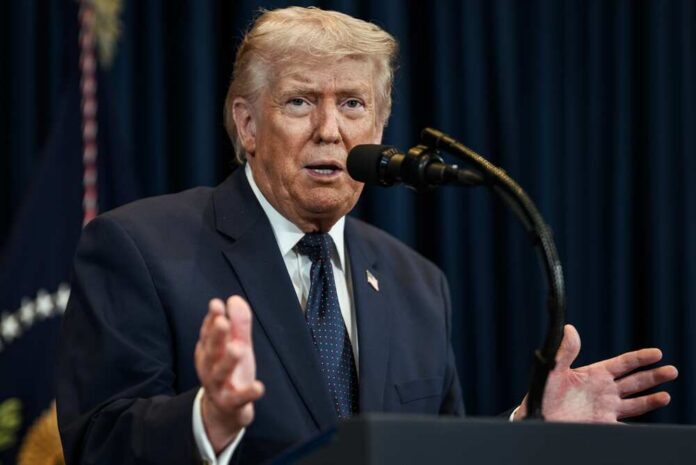
The same trade deal President Donald Trump once hailed as “the best ever” is now the weapon he is using to threaten Canada and Mexico—and to reshape how American workers live and earn.
Story Snapshot
- The USMCA remains in force, but Trump refused the automatic 16-year renewal and instead required annual reviews.
- The deal helped integrate North American manufacturing and added new labor protections, but critics say workers still got shortchanged.
- Trump now calls the pact flawed, using pressure to renew it and tariff threats to demand changes from Canada and Mexico.
- American workers sit in the crossfire while elites and trade lawyers argue over rules most voters never read.
Trump turns his own deal into a pressure lever
United States trade rules with Mexico and Canada ride today on a deal Donald Trump himself signed, renamed the United States-Mexico-Canada Agreement, and sold as a win for American workers and factories.
The agreement replaced the old North American Free Trade Agreement and kept most trade between the three countries free of tariffs, especially for manufactured goods. Trump praised it at the start. Now his administration has decided not to give it the long, automatic extension built into the deal.
Under Article 34.7 of the agreement, all three countries faced a choice in 2026: lock in another 16 years or leave the pact on a shorter leash. On July 1, the United States formally declined that automatic renewal and instead triggered an annual review process.
United States Trade Representative Jamieson Greer said the administration would not “rubber stamp” USMCA in its current form and pointed to “substantial issues” with the original agreement. That move keeps USMCA alive but under constant negotiation and threat.
What USMCA was supposed to fix for American workers
The agreement was sold to the public as a major upgrade over NAFTA. The Office of the United States Trade Representative describes USMCA as creating more “balanced, reciprocal trade” that should support high-paying jobs for Americans and strengthen domestic manufacturing.
Business groups like the Business Roundtable cheered it as a way to protect jobs in the United States and boost factories at home.
The deal also built tougher labor rules, especially aimed at Mexican factories. A new Rapid Response Labor Mechanism allows the United States to challenge individual facilities that block free unions or basic rights, requiring changes before shipments can move freely.
One major study estimates that this tool improved wages and conditions for tens of thousands of workers in Mexico. For many Americans, raising Mexican wages is not charity. It is a way to reduce the incentive to move jobs south just to chase cheap labor.
Why critics say the deal still failed working people
Despite the upgrades, the Economic Policy Institute, a left-leaning research group, argues there is no evidence that the USMCA has truly alleviated the downward pressure on manufacturing jobs and wages in the United States. Their analysis says the deal left big “back door” channels open for unfairly traded products to reach American shelves.
In plain terms, even with new rules, foreign producers can still undercut United States workers on price and play games with where goods are labeled as “made.” That hits the exact middle-class factory workers politicians promised to protect.
The same report concludes that USMCA “failed working people in all three countries” and calls for dramatic reform to put workers first. That aligns with a broader pattern.
Every major trade deal in recent decades has been sold as a modern fix, then attacked as another step in a system that helps multinational companies more than line workers.
Americans, especially those skeptical of big business, see a familiar story: promises of protection at the front end, followed by continued offshoring and wage pressure once the cameras leave.
Trump’s reversal and the new era of annual brinkmanship
The shock today is not that a trade deal has critics. The shock is that Trump, who branded USMCA as a signature win, now refuses to extend it as written.
The formal decision announced in July 2026 means the agreement remains in full force, including tariff exemptions and dispute rules, but only under the cloud of annual talks that can stretch for up to a decade. If the three countries cannot settle their differences, the pact simply expires in 2036 and trade rules revert to basic World Trade Organization terms.
USMCA REVIEW 2026: TRUMP SAYS NO — AND PUTS CANADA AND MEXICO ON NOTICE
On July 1, 2026, the United States officially refused to renew the USMCA.
U.S. Trade Representative Jamieson Greer issued the statement that will reverberate across North America for the next decade:
"The… pic.twitter.com/TvBRZOSNKR
— U.S. & Middle East News 🇺🇸 🇮🇱 🇵🇪 🇨🇴🇬🇧 (@Carlisitus) July 2, 2026
For Canada and Mexico, this is economic pressure. Analysts say a “suboptimal” scenario is already on the table, in which the United States demands higher United States content in autos and tight quotas on its farm and factory exports. For Trump, this is leverage.
Every annual review becomes a chance to threaten tariffs, demand concessions, and remind neighbors that access to the American market is not guaranteed.
For American workers, that strategy can cut both ways. Tougher rules might bring some production home, but constant uncertainty can freeze investment and hiring.
Where conservative common sense should focus now
The easy story line is about Trump drama and leaders clashing on television. The real stakes sit in places like Ohio, Michigan, Pennsylvania, Texas, and the border states where factories depend on steady cross-border supply chains.
On one side, USMCA’s supporters point to more integrated production, clearer rules, and new labor enforcement that at least tries to align Mexican standards with American expectations. On the other hand, worker advocates argue that the data still show flat wages and persistent job flight.
Americans should demand something simpler than slogans. First, prove whether USMCA raised pay and protected jobs in the sectors it claimed to help.
That means hard numbers on manufacturing wages and job counts since 2020, not talking points from lobbyists. Second, expose the scale of this “back door” for unfair imports and close it if the evidence backs the charge.
Finally, if Trump refuses renewal, he owes workers a clear replacement vision, not just more tariff threats. A trade deal should be judged by one question: does it let American families earn a decent living, in their own country, or not?
Sources:
abcnews.com, nbcnews.com, epi.org, cfr.org, ustr.gov, businessroundtable.org, en.wikipedia.org, cato.org