

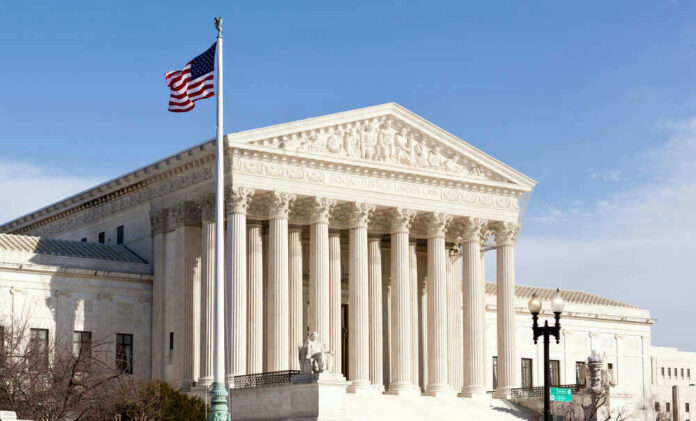
The Supreme Court has now said clearly that states may keep transgender males out of girls’ and women’s school sports to protect biological female athletes.
Story Snapshot
- Supreme Court ruled 6-3 that Title IX and the Constitution allow state bans on transgender athletes in girls’ and women’s teams.
- Justice Brett Kavanaugh wrote that “sex” in Title IX means biological sex, not gender identity, locking in the original 1972 understanding.
- The Court said safety and competitive fairness are the key reasons to keep female sports separated by biological sex.
- The decision shields similar laws in at least 27 states and aligns with President Trump’s push to defend women’s sports.
Supreme Court Backs States, Affirms Title IX Protects Biological Sex
Justice Brett Kavanaugh’s majority opinion in West Virginia v. B.P.J. confirms that states may draw lines in sports based on biological sex without violating the Constitution or Title IX.
The Court held that the term “sex” in the 1972 Title IX law “cannot plausibly be interpreted” as anything other than biological sex, rejecting efforts to rewrite the statute through modern gender ideology.
For conservatives, this is a major legal win for common sense, original meaning, and the protection of women’s opportunities in education and athletics.
The ruling grew out of challenges to laws in West Virginia and Idaho that require school and college teams to be separated by sex at birth and bar biological males from girls’ and women’s rosters.
A six-justice majority agreed these laws are lawful “sex-based classifications” because they are substantially related to a legitimate and important interest: giving girls and women fair and safe athletic opportunities. This directly backs the argument many parents and coaches have made for years, that biology still matters on the playing field.
Court Emphasizes Fairness and Safety for Girls and Women
In the opinion, Justice Kavanaugh stressed that “safety concerns and competitive fairness are the touchstones” for sex separation in sports. Supporters pointed to the obvious physical differences that develop through male puberty—greater speed, strength, size, and explosive power—and how those can erase the level playing field that Title IX was meant to create for female athletes.
More than one hundred athletes, coaches, and parents, including Olympians, urged the Court to uphold the bans so women do not lose medals, records, and scholarships to biological males.
BREAKING: The Supreme Court upholds state laws banning transgender girls and women from school athletic teams. pic.twitter.com/PrGSPDiedN
— NEWSMAX (@NEWSMAX) June 30, 2026
The Court noted that this is a “debated policy question” in science, especially for individuals who start puberty blockers early, but it did not try to resolve every medical dispute.
Instead, the justices asked a simpler question: do states have a reasonable basis to separate sports by biological sex to protect girls’ chances to compete? The majority answered yes.
That approach respects federalism, allowing states to respond to real-world concerns about injuries and lost opportunities without waiting for perfect data while female athletes bear the risks.
Decision Shields Laws in 27 States and Aligns With Trump Agenda
By upholding West Virginia and Idaho’s laws, the Supreme Court effectively protects similar bans across the country. NBC News and other outlets report that at least 27 states now limit transgender participation in girls’ and women’s school sports, and Justice Kavanaugh’s reasoning is expected to apply broadly to those statutes.
Earlier reporting showed a steady rise in such laws since 2020, as state lawmakers reacted to cases where biological males entered female competitions and raised fairness concerns. For many families, this decision finally brings legal clarity after years of confusion.
This ruling also fits with President Donald Trump’s second-term promise to defend women’s sports and restore the original meaning of civil rights laws. A 2025 executive order from the Trump administration directed agencies to interpret Title IX based on biological sex and to enforce that standard in education and athletics.
The Court’s embrace of that reading now gives the administration strong legal backing to press schools and colleges to follow suit, including through funding enforcement, while still leaving room for future debate over specific edge cases, such as California’s more permissive policies.
Media Uproar and Dissenting Justices Highlight Ongoing Battles
Major media outlets immediately framed the ruling as a “major blow” to lesbian, gay, bisexual, transgender, and queer rights and a “setback” for transgender individuals. The American Civil Liberties Union, which represented the transgender athletes, called the decision “devastating” and warned it would harm transgender youth.
Three liberal justices dissented in part, arguing that lower courts should examine some constitutional challenges by transgender students more closely and worrying that some students might be left without a way to argue their case.
The majority, however, focused on the rights of girls and women whose legal protections under Title IX were being quietly eroded. For decades, conservatives warned that redefining “sex” to mean gender identity would hollow out women’s sports and open the door to extreme policies on locker rooms and privacy.
This decision marks a turning point in that broader fight: the Court has said the text of Title IX still means what Congress wrote in 1972, and states may act to preserve that promise even as culture wars rage and twenty-three states continue facing related lawsuits.
SCOTUS Upholds Transgender Sports Bans
The Supreme Court upheld state bans on transgender athletes in girls' and women's sports, siding with West Virginia and Idaho in two closely watched cases.
Justice Brett Kavanaugh, writing for the majority, said that states may set… pic.twitter.com/RAUb0q4mhu
— ronald ham (@ronaldham15) July 1, 2026
Looking ahead, the ruling does not create a single nationwide rule for every detail of sports policy, but it sets firm outer boundaries that protect both the Constitution and Title IX from activist reinterpretation.
States remain free to experiment within those guardrails, but they may no longer be forced by courts or bureaucrats to pretend biological differences do not exist.
For conservatives who care about the rule of law and fair play for their daughters and granddaughters, this is a rare moment where the Supreme Court, the Trump administration, and common sense are all rowing in the same direction.
Sources:
apnews.com, nytimes.com, youtube.com, facebook.com, supremecourt.gov, mapresearch.org, bestcolleges.com, cronkitenews.azpbs.org