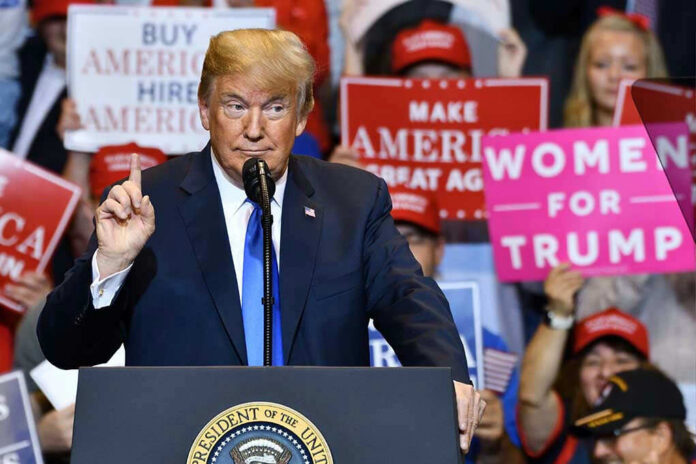
When a sitting president openly punishes his own party’s incumbent senator for insufficient personal loyalty, it confirms what many Americans already fear: the system now rewards obedience to power more than service to voters.
Story Snapshot
- President Donald Trump endorsed Texas Attorney General Ken Paxton over incumbent Republican Senator John Cornyn in a razor-thin Senate primary runoff.
- Trump’s statement framed Paxton as a “winner” and loyal “MAGA warrior,” while faulting Cornyn for being slow to back him after 2020.[1][2]
- Vice President J.D. Vance echoed that loyalty-based rationale, saying Paxton “was there for the country” when it counted.[3]
- Cornyn and other Republicans warn Paxton could jeopardize the seat in November, turning a safe-red state into a costly battleground.[4][5]
Trump Chooses Paxton, Signaling Loyalty Over Seniority
President Donald Trump formally endorsed Texas Attorney General Ken Paxton in the Republican primary runoff for United States Senate, bypassing sitting Senator John Cornyn despite Cornyn’s long tenure and higher profile in Washington.[1][2]
Trump used his Truth Social post to call Paxton a “winner” and describe him as an “America First patriot” and “true MAGA warrior,” language that ties Paxton directly to Trump’s brand rather than to institutional Republican leadership.[1] The endorsement immediately became the central story in an already heated race.[1][2]
Coverage of the announcement stressed how long Trump had waited to choose sides and how personal his final decision appeared.[1][2] Reporters noted Trump praised Paxton’s alignment with his agenda on border security, school choice, and energy production while criticizing Cornyn for being “very late in supporting” him after the 2020 election.[1]
That framing turned what could have been a conventional intraparty debate over experience and electability into a referendum on who stood closest to Trump when he felt under siege.[1][2]
A Close Race Supercharged By One Man’s Word
News outlets described the Paxton–Cornyn contest as extremely close even before the endorsement, with polling showing a narrow Paxton lead and both candidates clustered in the low forties among Republican voters.[1][6]
Commentators pointed out that the endorsement landed on the second day of early voting, only about a week before runoff day, meaning many ballots had already been cast.[1][2]
Analysts therefore framed Trump’s move less as creating a frontrunner from nothing and more as putting his stamp on a race where his base was already leaning toward Paxton.[1][2]
Vice President J.D. Vance publicly reinforced the loyalty narrative, saying that while he had known Cornyn for years, “when it really counted, Ken Paxton was there for the country” and for the president.[3]
That line underscored that the central qualification, at least in the White House’s telling, was standing with Trump during the hardest fights, rather than a comparative record of governing or legislative skill.[1][3]
For many voters already cynical about Washington, this looked less like a policy argument and more like internal power players rewarding personal allegiance.
Cornyn, Party Leaders, And Fears Of Losing Texas
Senator Cornyn responded by warning that Paxton could become “an albatross around the neck” of Republicans in November and might lose to Democrat James Talarico in the general election.[4]
Broadcast segments reported polling that suggested Cornyn ran slightly stronger than Paxton in hypothetical matchups against Talarico, feeding concerns among some Republicans that Trump’s choice could put a usually safe Texas seat at risk.[2][5]
Party figures cited Paxton’s legal controversies as part of the vulnerability, even if those issues were not the focus of Trump’s endorsement message.
Reports also highlighted that Cornyn actually finished first in the initial primary round, taking roughly 42% to Paxton’s 40.5%, which illustrates that a large share of Republican voters initially preferred the incumbent.[4]
Some Republican leaders reportedly lobbied Trump to back Cornyn on electability grounds, but their efforts clearly lost to the White House’s loyalty calculus.
For many Americans who already see both parties as controlled by self-protective insiders, the episode reinforced a sense that internal factional power matters more to leaders than minimizing risk for the people they claim to represent.
What The Endorsement Reveals About Today’s Politics
Political analysts observing the race argued that Trump’s decision in Texas fits a wider pattern in both parties: national leaders acting as “preference setters” in low-information primaries, using endorsements to discipline dissent and define who truly belongs inside the tent.
In such contests, the question becomes less “who will best serve constituents?” and more “which team are you on?” That dynamic feeds the growing belief on both the right and the left that politicians answer primarily to party bosses, donors, and media narratives rather than to ordinary voters.
Trump Gives Ken Paxton ‘Complete and Total Endorsement’ in Texas Senate Primary Against John Cornynhttps://t.co/K10AN1Fyi1
— Karen Slaton (@KarenSlato45240) May 20, 2026
The Paxton endorsement especially resonates with voters who feel that Washington operates like a closed club, where loyalty to powerful figures matters more than integrity, transparency, or basic competence.
Trump’s critics see the move as proof that a single man’s grievances can reshape a major Senate race.
His supporters see it as a necessary correction to an out-of-touch Republican establishment. For many frustrated Americans across the spectrum, both reactions point to the same unsettling truth: the system is still about them, not us.
Sources:
[1] YouTube – Trump Endorses Ken Paxton In Texas GOP Senate Primary Runoff
[2] YouTube – Trump endorses Ken Paxton in Texas GOP Senate runoff
[3] YouTube – VP Vance on President Trump Endorsing Ken Paxton in …
[4] Web – Trump endorses Ken Paxton in Senate GOP runoff
[5] Web – Trump endorses Ken Paxton over GOP incumbent John Cornyn in …
[6] YouTube – Trump Taps Paxton Over Incumbent Cornyn in Texas Senate Race