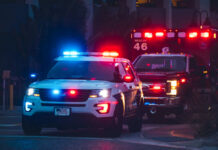


A 32-year-old woman died and a man was wounded after a swift, “unprovoked” knife attack in Times Square, and police shot the suspect minutes later.
Story Snapshot
- Police say a woman armed with two knives stabbed two people on Seventh Avenue
- The suspect, identified as 49-year-old Pamela Cisneros of Queens, was shot by police
- A female victim died at the hospital; a male victim remains hospitalized
- NYPD says the suspect had prior mental health contacts in 2018 and 2019, with no arrests
A crowded corner turns deadly in minutes
Police said officers rushed to West 43rd Street and Seventh Avenue just after 4:20 p.m. on August 31, after calls about a woman stabbing people along Seventh Avenue. The scene is one of the densest blocks in New York.
Families, office workers, and tourists move in every direction. Amid that crush, officials say the suspect used two knives. One woman was stabbed and later died at the hospital. A man was stabbed and remained hospitalized, according to the department’s update.
Police Commissioner Jessica Tisch described the attack as an “unprovoked double stabbing” and said officers confronted the suspect soon after the first 911 calls.
The commissioner said the suspect, identified as 49-year-old Pamela Cisneros of Queens, was shot and killed by police during the response. The fast arrival tracks with the location. Midtown South and Times Square units are close, and foot posts are common there. Seconds matter on that corner; officers know it.
What police say about the suspect and prior contacts
Commissioner Tisch said the suspect had a documented mental health history known to the New York Police Department, with incidents in 2018 and 2019 but no arrests tied to those contacts. That detail fits a wider pattern seen in major cities.
Many police uses of force occur during clear signs of crisis, not only during traditional crime stops. A national study of injurious police shootings found that almost one in four involved mental or behavioral health symptoms or substance use. Those are not edge cases; they are a core part of modern patrol work.
🚨🇺🇸 BREAKING: NYPD officers fatally shot a knife-wielding woman in Times Square, NYC, after she allegedly attacked two people and advanced toward police. One victim was killed and another injured.
#NYC #NYPD #usa #viral #breaking #women #america pic.twitter.com/hv5fGIlIN5
— pradhyumn sharma (@pradhyu78651514) September 1, 2026
That mix of public safety and health risk raises a hard truth for cities. Times Square is built for speed and spectacle, not for crisis care on the sidewalk.
Officers must stop an active threat at once. Yet many suspects are not hardened criminals. They are in a break, a spiral, or a fog. Policy debates return to the same tension: who shows up first, with what tools, and how fast can backup arrive when a knife is already moving?
How a “random” attack scrambles risk in a tourist hub
Police framed the attack as unprovoked. That word hits hard in a place where people feel safe in a crowd. Most victims in public stabbings do not know the attacker. That randomness hurts public trust more than a feud or a robbery would.
Times Square has seen high-profile threats before, from plots to lone actors. Officials often move fast to classify an event. When facts point to mental health over ideology, coverage tends to settle on the narrower criminal story unless evidence shifts later.
Bank of America Vice President Erin Piacenti Killed in Times Square Stabbing pic.twitter.com/1yXnDSQQo3
— Breaking X (@BreakingXAlerts) September 1, 2026
Tourist hubs stack risks. A single attacker can reach many people in seconds. Knives are easy to hide and need no skill to use. Police posture in these zones is built on deterrence, fast eyes, and fast feet.
Cameras help after the fact. Boots on the ground matter in the first minute. The reported timeline shows how a short sprint down one avenue can change many lives before the next light turns green.
What common-sense reforms still look like
New York has added mental health teams and training over the years, but street reality still demands clear lines. Dispatchers need tight scripts to tag crisis cues early. Supervisors must get less-lethal tools and shields on scene quickly.
Prosecutors and health partners need faster pathways to mandate treatment when clear risk signs recur. Common sense says public safety comes first. That means giving cops the tools and backup to end a threat, and giving courts the leverage to act before the next break.
Officials have not released every record linked to this case. That is common in early hours after a shooting. The core facts are not in dispute: two people stabbed on Seventh Avenue; one woman died; a man is in the hospital; the named suspect was shot by police during the response.
The next steps are predictable. The department will examine body-worn camera footage, call logs, and use-of-force files. Those reviews matter for training, not only for blame. The goal is fewer knives reaching victims before help arrives.