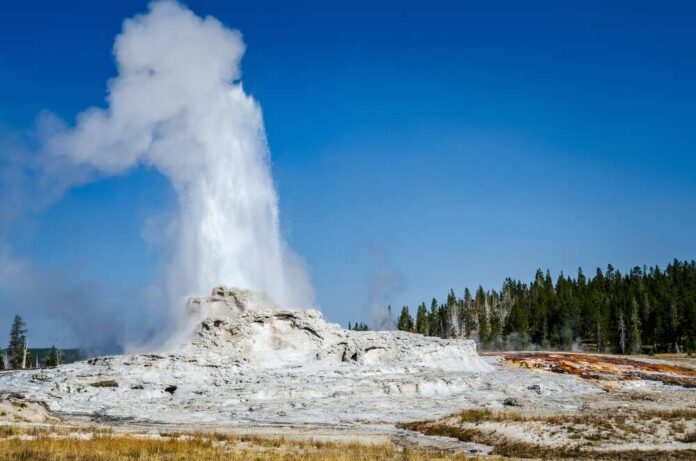
Yellowstone’s largest acidic geyser roared back to life after more than five years of silence, reminding Americans that our nation’s natural treasures operate on their own timeline—not the government’s—and showcasing the power of proper scientific monitoring over alarmist fearmongering.
Story Highlights
- Echinus Geyser in Yellowstone’s Norris Basin resumed eruptions on February 7, 2026, after lying dormant since December 2020
- USGS sensors detected the awakening early, tracking approximately 40 eruptions shooting water 20-30 feet high by late February
- Federal scientists quickly dispelled volcanic panic, confirming the activity represents normal hydrothermal cycles with no threat to public safety
- The geyser’s unique acidic chemistry and striking red iron oxide colors distinguish it from Yellowstone’s more predictable geysers like Old Faithful
Echinus Geyser Breaks Five-Year Silence
The Echinus Geyser, recognized as the world’s largest acidic geyser, resumed spectacular eruptions in Yellowstone National Park’s Norris Geyser Basin on February 7, 2026.
Temperature sensors installed in runoff channels detected initial surges in early February, with eruptions becoming regular every 2 to 5 hours starting on February 16.
By late February, scientists counted approximately 40 eruptions from the 20-meter-wide pool rimmed with distinctive silica deposits. Each eruption launches sulfur-scented water 20 to 30 feet skyward for two to three minutes, creating a natural spectacle that draws thousands of visitors to witness American geological heritage in action.
For the first time since 2020, Echinus Geyser (Norris Geyser Basin, Yellowstone National Park) is erupting! Caldera Chronicles has the details about the show. https://t.co/Ml6NOqyw2W
📷1: Echinus Geyser, seen from above in a photo taken by a research balloon in 2005. The… pic.twitter.com/z4GyqW8xNd
— USGS Volcanoes🌋 (@USGSVolcanoes) March 2, 2026
Federal Scientists Provide Steady Reassurance
The United States Geological Survey’s Yellowstone Volcano Observatory announced the geyser’s reawakening on March 2, 2026, emphasizing the geyser’s temporary and cyclical nature.
USGS officials stated, “Echinus Geyser is back in action! For now…” while stressing no volcanic threat exists, only normal hydrothermal dynamics.
This measured response contrasts sharply with the breathless panic we’ve seen from media outlets eager to sensationalize natural events. Federal scientists noted that in February 2026, only 74 minor earthquakes with a maximum magnitude of 2.4 were recorded, well within background activity levels.
The National Park Service coordinates with USGS to ensure visitor safety while preserving access to this remarkable natural feature, demonstrating effective interagency cooperation without bureaucratic overreach.
Norris Basin’s Unique Geothermal Character
Norris Geyser Basin represents Yellowstone’s hottest and most acidic thermal area, hosting the world’s largest acidic geyser due to unique chemical reactions that lower pH levels compared to typical alkaline hot springs.
Echinus displays irregular behavior patterns—active phases lasting months, followed by years of dormancy—driven by Yellowstone’s supervolcano caldera, which heats groundwater to extreme temperatures. This builds pressure until explosive release occurs through the geyser’s distinctive silica-rimmed opening.
The red coloration from iron oxides and unpredictable timing distinguish Echinus from predictable geysers, making it a prime example of nature’s power operating beyond human control or scheduling preferences.
Historical Patterns Support Current Activity
Echinus Geyser’s last active phase concluded in December 2020, with dormancy aligning with natural cycles similar to patterns observed in 2017. The 2003 Norris Basin surge prompted the USGS to install permanent temperature-monitoring sensors, creating a reliable early-warning system that detected the 2026 reawakening.
These investments in scientific infrastructure—made during previous administrations—now pay dividends by providing real-time data without requiring emergency funding or government expansion.
Nearby Steamboat Geyser, the world’s tallest active geyser, also erupted in late February 2026, demonstrating correlated activity typical of Norris Basin’s interconnected hydrothermal plumbing.
Historical records confirm these fluctuations represent normal geological processes rather than precursors to catastrophic volcanic events that left-leaning media outlets love to hype for clicks.
Tourism Benefits and Scientific Value
The geyser’s resumption provides immediate benefits for Yellowstone’s tourism economy, which generates approximately $500 million annually park-wide and supports thousands of American jobs in gateway communities. Visitors gain safe viewing opportunities to witness geological processes that built this nation’s landscape over millennia, fostering appreciation for conservation and natural heritage.
Long-term scientific value includes refined hydrothermal models and geothermal research applications, all achieved through existing monitoring infrastructure without requiring new government programs or spending.
The activity reinforces the importance of maintaining federal science agencies focused on core missions—monitoring natural hazards and educating the public—rather than chasing woke agendas or climate fearmongering.
USGS and National Park Service collaboration since 2003 demonstrates how limited, focused government investment in legitimate scientific monitoring serves the public interest without bureaucratic bloat or mission creep that plagued agencies during previous administrations.
Sources:
World’s largest acidic geyser bursts into red colours. Know the science behind – India Today
Echinus Geyser is back in action! For now… – USGS Yellowstone Volcano Observatory
World’s largest acidic geyser erupts again in Yellowstone after years of silence – Popular Science
Geyser Activity – Yellowstone National Park Service