

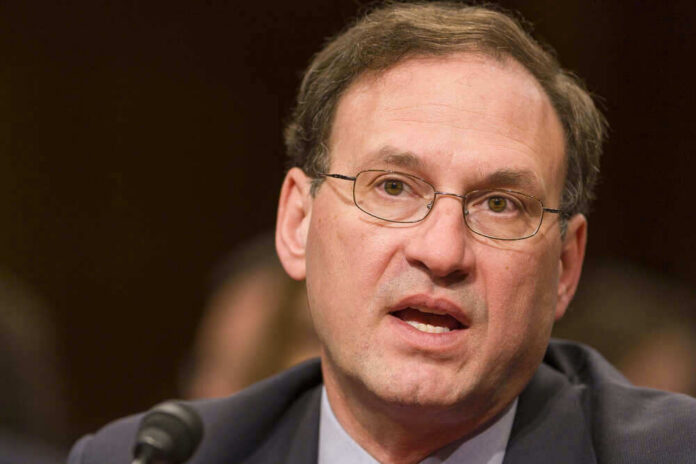
A one-sentence Supreme Court notice quietly pulled Justice Samuel Alito from the term’s biggest climate-law fight, and the timing matters.
Story Snapshot
- The Supreme Court clerk told both sides that Alito will not take part.
- The recusal came a week before oral arguments in Suncor v. Boulder.
- Major outlets confirmed the step-back that day.
- The case tests if climate-liability claims can stay in state court.
What Alito’s Exit Changes Right Now
Clerk of the Court Scott S. Harris sent a brief letter on September 28, 2026. It said Justice Alito “will not continue to participate” in Suncor Energy Inc. v. County Commissioners of Boulder County.
Lawyers for both sides received the notice ahead of the October 5 argument date, which locked in the new eight-Justice lineup before the first question is asked. Multiple national outlets reported the recusal the same day, confirming the development.
Alito bows out of blockbuster Supreme Court climate case https://t.co/w6l6i5s4Zo
— POLITICO (@politico) September 28, 2026
The Court did not give a reason in the letter. Reports tied the move to Alito’s stock ownership in oil and gas companies, though not in the named parties Exxon Mobil or Suncor Energy.
Those write-ups flagged the federal recusal statute’s rules for financial interests, which require disqualification in certain situations, but the official notice stood on its own and did not explain the basis.
The Case Beneath the Headlines
The dispute grew out of Boulder’s lawsuit seeking to hold energy companies liable under state law for climate-related harms. The Supreme Court took the case to decide a threshold gatekeeping issue: which court system should hear it.
The central question is whether federal law requires these claims to move to federal court or whether they can proceed in state court. The answer will shape where dozens of similar cases land next.
Oil companies argue that broad federal interests and statutes dominate climate policy, which would push these cases into federal court. Cities and counties point to well-known limits on “complete preemption” and say their claims fit long-standing state law buckets like deception or nuisance.
Congress’s own research service has called complete preemption rare and dependent on clear congressional intent, a standard that often keeps state claims in state court.
Why An Eight-Justice Court Matters
An eight-Justice Court raises the risk of a four-to-four tie. A deadlock would affirm the lower court result without a written opinion and without a national rule. That outcome would leave other climate-liability suits to fight on, case by case, across different states. Businesses prefer one clear federal answer.
Cities prefer to press forward under state consumer protection and tort theories. The forum fight decides who holds the chalk on the next plays, not the final score.
U.S. Supreme Court Justice Samuel Alito announced his recusal from the major climate change case Suncor Energy Inc. v. County Commissioners of Boulder County, stepping aside following intense public scrutiny over his personal financial holdings in oil and gas companies#News pic.twitter.com/iIl0D5Sj7E
— PEER COMMUNITY HUB, Our Empowerment Zone! 🇨🇦✌️ (@p_communityhub) September 29, 2026
Americans prize clear rules, limited judicial freelancing, and respect for elected lawmakers. On that score, a narrow, text-first answer to jurisdiction is the proper path. If Congress wanted every climate-liability case in federal court, it could say so in bold print.
Courts then would follow that command. Until then, the basic rule holds: the plaintiff is the master of the complaint, and state claims usually stay where they were filed, absent a clear federal hook.
How Recusal Fits The Court’s Quiet Norms
Supreme Court recusals are often bare-bones. Justices rarely explain their choices, and no one reviews them afterward. Legal scholars have long noted that this practice keeps the spotlight on the case itself and avoids pulling the Court into side fights over a Justice’s personal decisions. But it also leaves the public to infer reasons from general ethics rules and financial disclosures, not from a written order.
Federal law sets bright lines for when a Justice must step aside, including for certain financial interests. The code aims to protect confidence in the Court, which conservatives see as vital to the rule of law.
In this instance, the clerk’s notice told litigants what they needed most: the lineup and the timing. The Court kept the schedule, preserved predictability, and let the argument focus on the controlling law, not the Justice.
What To Watch Next
Watch for questions about the scope of federal preemption and how the Justices frame the “rare exception” of complete preemption. Listen for signals about whether deception-based or consumer protection claims can proceed in state court.
A clean ruling that sets a narrow, durable test would give businesses and cities a rule they can plan around. That outcome reduces forum-shopping, trims legal costs, and respects Congress as the ultimate author of any sweeping change.
Sources:
cbsnews.com, abcnews.com, reuters.com, cnbc.com, thehill.com, politico.com, dailycaller.com, cnn.com, harvardlawreview.org, congress.gov