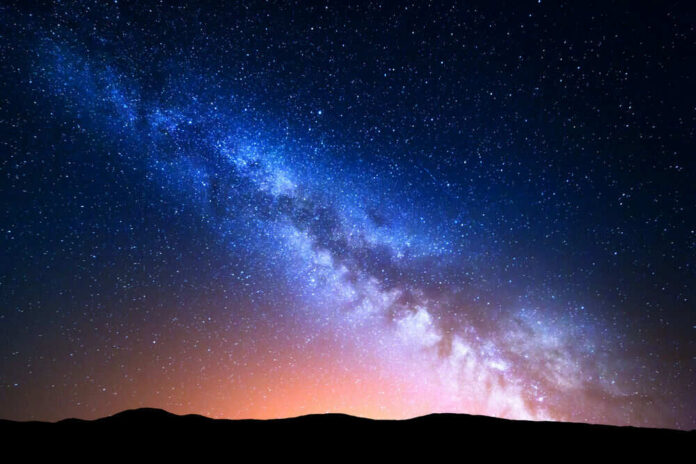
Two specks of light, burning with a trillion suns, are forcing us to rethink how fast the universe built its first monsters.
Story Snapshot
- Euclid found 31 ancient quasars, more than doubling the known population of these early cosmic beacons.
- Two quasars date to just 670 million years after the Big Bang, now the earliest ever observed.
- Their black holes grew far faster than standard models of the young universe can easily explain.
- The discovery is real, but how “record-breaking” it truly is will depend on what follow-up data reveal.
Euclid’s wide cosmic survey hits a record
The Euclid space telescope was built to map dark energy, not chase the most exotic objects in the universe. Yet in its early wide survey, Euclid flagged 31 new quasars that shine from the universe’s first few percent of history.
Fourteen of them sit at redshift 7 or higher, which means their light began its journey when the cosmos was astonishingly young, less than a billion years old. That alone makes this sample a gold mine.
Oldest quasars ever discovered add to ‘perplexing’ space mystery https://t.co/VYhp4rPZac
— The Straits Times (@straits_times) July 6, 2026
Two of these quasars stand out from the pack. Their measured redshifts are 7.69 and 7.77, placing them at about 13 billion light-years away and corresponding to a time just 670 million years after the Big Bang.
Before Euclid, the title of the earliest known quasar belonged to J0313-1806, found at a redshift of 7.64 and linked to the same 670-million-year era. The new pair nudges that frontier a bit farther back, even if the age difference sounds tiny to human ears.
What these quasars really are: black holes lighting up the early universe
A quasar is what you get when a supermassive black hole feeds so aggressively that the matter around it outshines an entire galaxy. Gas spirals into the black hole, heats up, and blasts energy across space. The two Euclid record-setters radiated as brightly as a trillion suns.
That kind of output demands black holes with masses hundreds of millions to billions of times our Sun’s, formed in less than 670 million years. That growth rate is where the real puzzle begins.
Standard models say black holes should start small, from the deaths of massive stars, and then grow over time by swallowing gas and merging with other black holes. That path has limits. You cannot feed a black hole at a rate above a certain threshold without radiation pushing material away.
Hitting “trillion sun” brightness so early strains those rules. These Euclid quasars, along with earlier finds like J0313-1806, are part of a growing list of objects that seem to have gained mass faster than our current math would predict.
Why this matters for the early universe
These quasars do more than set a headline record. Their light carries information about the foggy era when the first stars and galaxies burned away the cosmic dark ages. At a redshift of around 7.7, the universe was still filled with neutral hydrogen gas that absorbs certain wavelengths.
Quasar light passing through that gas lets astronomers see how quickly the universe became transparent. That helps test big-picture models of how structure formed and how soon the first large objects appeared.
The Euclid space telescope has spotted the oldest quasars ever discovered — from when the universe was just 670 million years old, only 5% of its current age .
Quasars are powered by supermassive black holes, shining trillions of times brighter than the Sun. The discovery beats… pic.twitter.com/X8vAeZa25n
— Hype Pakistan (@HypePakistan) July 6, 2026
There is also a values question hiding here. Many media outlets frame every slight redshift gain as a new “oldest ever,” chasing clicks and funding buzz. Yet the Euclid story, backed by a peer-reviewed paper in Astronomy and Astrophysics, is not just hype.
The team more than doubled the census of very early quasars and pinned down two that truly beat the previous record by a small but real margin.
Hype, records, and the need for patience
Early-universe astronomy has a history of record-breaking claims that soften once better data arrive. The James Webb Space Telescope had its own round of “earliest galaxies ever,” which later shifted as detailed spectroscopy narrowed down their ages.
Euclid’s discovery will almost certainly face the same reality check. Other observatories will re-measure these quasars, refine their redshifts, and estimate their black hole masses. Some numbers will change. That does not mean the original result was dishonest. It means the scientific process works.
There is a tension built into this kind of work. Space agencies and universities have strong incentives to celebrate every record—they need public interest and funding. Social platforms reward bold claims like “oldest ever” more than sober language such as “slightly earlier than the previous record.”
At the same time, many astronomers worry that excessive hype erodes trust when later corrections are made. The Euclid quasar paper tries to walk this line, putting hard numbers first and media spin second. That approach deserves attention.
What comes next: testing the limits of black hole growth
The real action now moves to follow-up studies. The Euclid team and others will use ground-based telescopes and the James Webb Space Telescope to measure these quasars in more detail.
They will look for the masses of the central black holes, the rates at which they consume matter, and signs of their host galaxies. If these black holes are as large as their brightness suggests, then theorists must explain how such giants formed so fast without breaking basic physical limits.
Several ideas compete. One is that some black holes started large, collapsing directly from massive clouds of gas rather than from single stars. Another is that dense early regions allowed runaway growth through constant feeding and rapid mergers.
These scenarios carry different predictions about how many early quasars should exist and what their environments look like. Euclid’s 31-object sample, drawn from a survey that will cover a third of the sky, finally provides enough data to seriously test those predictions. That is the deeper story here.
Sources:
cbsnews.com, biz.chosun.com, keckobservatory.org, ebsco.com, en.wikipedia.org, physics.aps.org