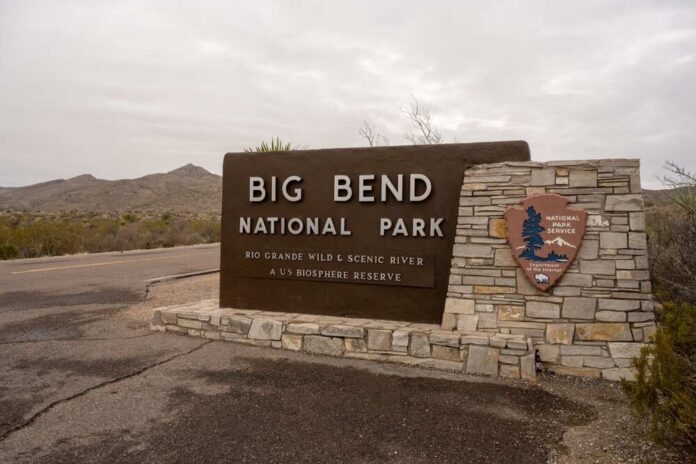
Crews are breaking ground for a steel-and-sensors border barrier across remote Big Bend, and the blueprint is bigger than most people think.
Story Snapshot
- Homeland Security waived key laws to speed construction in Big Bend in February 2026.
- Customs and Border Protection plans a “border barrier system” with 30-foot steel, roads, lights, and cameras.
- Big Bend’s crossings are a small share of the border total, fueling local backlash and lawsuits.
- Apprehensions fell 74% since 2023, yet the sector still records illegal entries and smuggling attempts.
What Washington Authorized And Where The Bulldozers Go
The Department of Homeland Security issued a formal waiver on February 17, 2026 to fast-track border barrier projects in the Big Bend Sector. The waiver set aside environmental and cultural-resource laws to move construction forward on federal timelines.
Customs and Border Protection documents describe 175 miles of “border barrier system construction” across Hudspeth, Jeff Davis, and Presidio counties.
The plan lists 30-foot steel bollards, patrol roads, lighting poles, fiber and power lines, drainage gates, and surveillance cameras as core parts of the build.
Trump administration begins construction on Texas’s Big Bend border wallhttps://t.co/0dwLbjanFJ
— The Hill (@thehill) September 19, 2026
Planning materials describe a layered approach, not just fence panels. The agency’s mapping and project language include primary and secondary barriers, waterborne defenses, patrol access, and detection technology to connect the system end to end.
This tracks with the broader idea that a barrier works only when paired with roads, sensors, and quick response. That is basic tradecraft at the border and aligns with the best practices agents ask for in tough terrain.
Why Build Here If Crossings Are Lower?
Critics ask why Big Bend needs steel when its share of encounters is small compared with other sectors. Customs and Border Protection reporting shows apprehensions dropped to about 3,096 in fiscal year 2025, down 74% from 2023 levels. That drop is real.
It does not mean the sector is sealed or quiet enough to ignore. Agents still catch people and seize loads. Federal planners argue that a layered system preserves deterrence and stops flows from bouncing into softer spots along the river.
The necessity case faces two clear weaknesses. First, the public record does not show a Big Bend-specific study proving steel outperforms technology or patrols in canyons and desert. Second, agency maps shifted over time, at times swapping long wall runs for detection zones, then revising again. That wobble clouds the final scope and invites doubt about where steel ends and sensors start.
Local Pushback, Lawsuits, And The Park-Sector Fault Line
Opposition formed fast. Texas ranchers, businesses, and a conservation nonprofit filed suit to stop construction across private lands and park-adjacent corridors.
More than 130 groups urged Congress to block funding for walls through Big Bend National Park and Big Bend Ranch State Park, citing damage to a tourism economy, dark skies, and wildlife corridors. A letter to Senate appropriators pressed the case that the waivers cut past safeguards that protect sensitive sites and public heritage.
Customs and Border Protection’s landowner letters, meanwhile, outline easements, purchases, or condemnation if talks fail. One rancher says the route would cross property tied to a state archaeological landmark, raising legal and cultural alarms.
This is where the project meets Texas instincts about land, limited government, and due process. Even supporters of stronger borders expect transparent takings, clear compensation, and proof that each mile adds security that technology alone cannot match.
What A Serious, Results-First Plan Should Prove Next
Federal planners have checked the legal box to build, but they have not closed the argument. The next step should be a public, sector-level scorecard. Show where steel will go, why that exact ground demands it, what sensors will cover, and how agents will respond.
Commit to before-and-after metrics on crossings, rescues, smuggling interdictions, and response times. If the system works as designed, the data will back the spend. If not, shift to a lighter tech footprint where terrain already does the job.
Americans can hold two ideas at once. Borders must be secure, and national treasures must be guarded. Big Bend’s plan should honor both. Build the miles that close clear gaps.
Use cameras, ground radar, and river access where canyons and cliffs already block vehicles. Keep lights shielded and roads minimal near dark-sky zones. Respect private property and compensate fairly and fast. Targeted, measured, and humble security will win more trust than any slogan or map redraw.
Sources:
doggett.house.gov, marfapublicradio.org, dallasexpress.com, yahoo.com, nobigbendwall.org, ourpubliclandsandwaters.substack.com, ca.news.yahoo.com, earthjustice.org, latimes.com