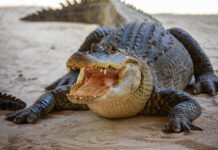
An alligator was found with human remains in a Louisiana lagoon where a missing autistic boy’s body was previously located.
Story Snapshot
- Hunters in Louisiana discovered human remains inside an alligator captured from a lagoon where a missing autistic boy was recently found dead.
- The event highlights the ongoing risk large alligators pose to people in regions where wildlife and human activity intersect.
- Authorities have not yet confirmed if the remains are those of the missing boy, as forensic analysis is ongoing.
- The discovery has sparked renewed calls for stricter wildlife management and public safety measures.
Human Remains Discovered Inside Alligator in Louisiana Lagoon
Hunters in Louisiana recently captured and killed an alligator from a lagoon that had been the site of a missing persons investigation involving an autistic boy.
Upon examining the animal, hunters found what appeared to be the upper portion of human remains inside the alligator.
This lagoon, frequented by local residents, is a known habitat for large alligators, raising concerns about the intersection of wildlife risk and public safety. The event has unsettled the community and prompted immediate action from local authorities.
Louisiana hunters find human remains inside alligator captured where missing autistic boy’s body was dredged from lagoon https://t.co/Gi5lCul1Kb pic.twitter.com/6nXBUFWJj5
— New York Post (@nypost) September 10, 2025
The shocking discovery came just days after the recovery of the missing boy’s body from the same lagoon. Wildlife officials and law enforcement are now working to determine if the remains found inside the alligator belong to the same child or possibly another individual.
Medical examiners and forensic teams are conducting thorough investigations, but as of now, no official identification has been released. The incident has placed a spotlight on the responsibilities of wildlife management and the safety protocols in place for communities living near such potentially dangerous habitats.
Context: Rare but Real Dangers of Alligator Encounters
Alligator attacks on humans are rare in the United States, but they are not unheard of, especially in southern states like Louisiana and Florida, where the populations of these large reptiles are significant.
Similar events have occurred before, including a 2023 case in Florida where a 13-foot alligator was found with human remains in its jaws. These incidents underscore the risks posed by overlapping human and wildlife territories, particularly in areas that are both recreational spaces and natural habitats for large predators.
Historically, such attacks often generate widespread public concern and intense scrutiny of wildlife management practices. Many local residents and families now question whether enough is being done to protect people—especially children and vulnerable individuals—from the dangers lurking in nearby wetlands and lagoons.
The balance between conservation and public safety is once again being debated, with some demanding stronger measures to control or relocate potentially dangerous wildlife from populated areas.
Stakeholders: Families, Community, and Wildlife Authorities
The primary stakeholders affected by this tragedy are the family of the missing boy, who are seeking closure and answers, and the local community, which relies on the lagoon for recreation and livelihood. Hunters, motivated by both public safety and wildlife management, played a key role in the discovery.
Law enforcement agencies and the Louisiana Department of Wildlife and Fisheries are leading the investigation and public communication efforts, while forensic experts attempt to provide definitive identification of the remains.
These parties are now under public and political pressure to ensure transparent handling of the case and to implement effective safety measures going forward.
Wildlife officials hold significant decision-making power regarding the management of local animal populations, including the capture of potentially dangerous alligators.
Their actions and the outcomes of the ongoing investigation will likely influence future policies on wildlife control and public safety in the region. The broader community, meanwhile, is demanding that its concerns be addressed, particularly regarding the protection of its most vulnerable members.
Ongoing Investigation and Calls for Action
As forensic analysis continues, the identity of the human remains found inside the alligator remains uncertain. Authorities have emphasized that the investigation is ongoing and have not ruled out the possibility that the alligator may have attacked the missing child or scavenged after the fact.
In the short term, the community is grappling with trauma, fear, and renewed calls for enhanced wildlife management.
Some experts advocate for increased monitoring, culling, or relocation of large alligators near populated areas, while others stress the need for better public education and safety protocols.
The event’s impact could extend beyond the immediate community, potentially influencing local tourism and recreation if fears about safety persist. Politically, local authorities may face demands for stricter regulations and more aggressive wildlife management to prevent future tragedies.
As the investigation unfolds, the need for a balanced approach—one that respects both public safety and responsible wildlife stewardship—remains a focal point for stakeholders and policymakers alike.
Sources:
Alligator killed in Florida after authorities find human remains in its jaws – AOL
Alligator involved in Pinellas County death investigation underway, authorities say – Fox 13 News