
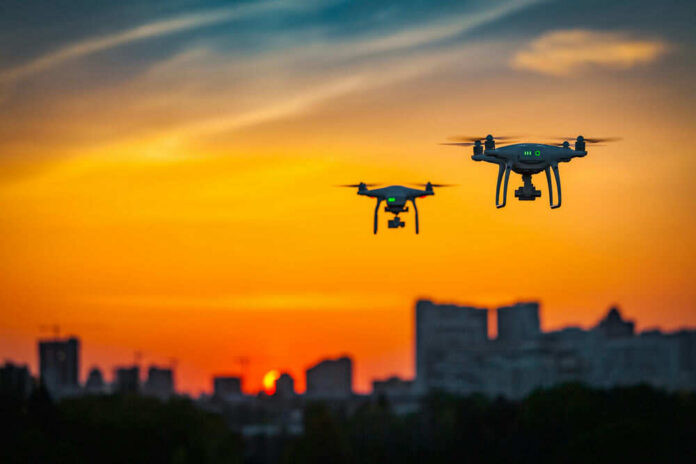
A small, shiny red drone operating at 3,000 feet nearly collided with a United Airlines Boeing 737 carrying 49 passengers during its final approach to San Diego International Airport.
Story Snapshot
- United Flight 1980 spotted a drone at 3,000 feet during landing approach, seven times higher than the legal 400-foot recreational drone limit
- The Boeing 737 was at 4,000 feet with the drone positioned just 1,000 feet below during a critical flight phase
- Post-flight inspection revealed no damage, though aviation experts warn a direct engine strike could have caused catastrophic failure
- The FAA launched an investigation while the drone operator remains unidentified and at large
A Brazen Violation of Restricted Airspace
The incident occurred at approximately 8:20 a.m. on Wednesday when pilots aboard United Flight 1980 from San Francisco alerted air traffic control to the unauthorized drone hovering in restricted airspace.
The crew described spotting what appeared to be a small, shiny red drone while descending through 4,000 feet.
Federal aviation regulations explicitly prohibit recreational drones from operating above 400 feet without special FAA authorization and ban all drone activity in restricted airspace surrounding major airports.
This operator was flying at 3,000 feet, nearly eight times the legal ceiling, demonstrating either stunning ignorance or willful contempt for public safety.
Air traffic controllers immediately warned other aircraft in the vicinity, though no additional pilots reported drone sightings.
The Boeing 737, carrying 49 passengers and six crew members, continued its approach and landed safely at San Diego International Airport.
United Airlines maintenance personnel conducted a thorough post-flight inspection and confirmed no structural damage occurred.
Passengers disembarked normally, likely unaware of the near-miss that had transpired above the Southern California coastline during their descent.
When Convenience Trumps Common Sense
The FAA’s investigation highlights a troubling pattern of unauthorized drone operations near major aviation hubs across the country.
While drone technology has democratized aerial photography and created legitimate commercial opportunities, it has also emboldened hobbyists who ignore basic safety protocols.
The regulations restricting drone altitude and proximity to airports exist for straightforward reasons:
Commercial aircraft travel at high speeds, pilots have limited reaction time during critical flight phases, and even small objects can cause devastating damage when ingested into jet engines or striking cockpit windscreens at hundreds of miles per hour.
Former Air Force accident investigator Rich Martin Del provided crucial context that many drone operators fail to grasp.
He emphasized the incident could have produced a far more serious outcome had the drone struck one of the aircraft’s engines.
Jet engines operate by drawing massive volumes of air through precisely engineered turbine blades spinning at extraordinary speeds.
Foreign object debris, even something as seemingly inconsequential as a small drone, can shatter these blades, triggering catastrophic engine failure.
During approach and landing, when aircraft operate at lower altitudes and slower speeds with limited options for emergency maneuvering, such failures present existential threats to everyone aboard.
The Enforcement Gap Nobody Wants to Address
The FAA issued reminders about drone regulations following the incident, but reminders accomplish little when violators face minimal consequences.
Federal authorities must identify the operator responsible for this reckless flight, and prosecutors should pursue maximum penalties available under existing law.
The aviation community cannot afford a culture where hobbyists treat restricted airspace as their personal playground.
Every commercial flight carries hundreds of passengers who trust that regulatory frameworks protect them from preventable hazards.
When drone operators flagrantly violate altitude restrictions in airport approach paths, they gamble with lives beyond their own.
United flight from San Francisco to San Diego reports close call with drone just before landing.#Drone #UAV #closecall https://t.co/XksIKQGkjG
— SmartFlight (@SmartFlightInfo) April 30, 2026
The investigation continues, but the drone operator’s identity remains unknown. Without on-the-ground witnesses or registration tracking, the FAA faces significant challenges in enforcement.
This case exemplifies why stronger detection systems and enhanced penalties deserve serious consideration.
Until drone operators face meaningful accountability for violations that endanger commercial aviation, these incidents will continue, and eventually, luck will run out.
Sources:
United Airlines pilots report close call with an apparent drone on California flight
United flight from San Francisco to San Diego reports close call with drone just before landing
United Airlines pilot reports drone strike on approach to San Diego airport, FAA says
United Airlines flight hits drone above San Diego International Airport