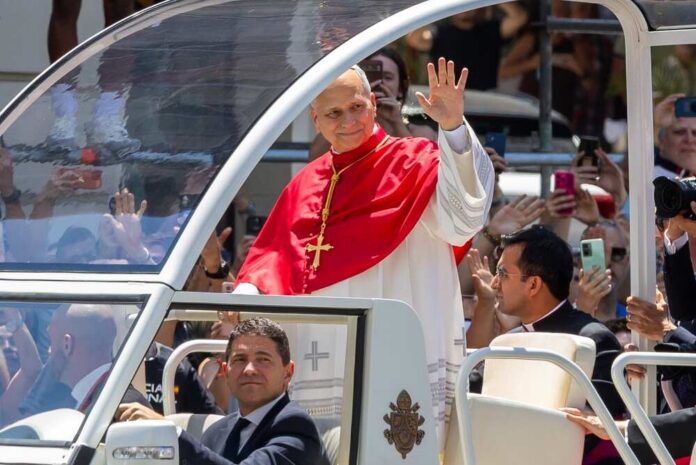
An American-born pope stood on a migrant island on July 4 and told the United States it cannot call itself “pro-life” while turning its back on immigrants.
Story Snapshot
- Pope Leo XIV used America’s 250th birthday to urge the U.S. to welcome, protect, and defend immigrants.
- He tied immigration directly to Catholic teaching on human dignity and the defense of life from conception to natural death.
- His message clashes hard with President Trump’s restrictive immigration agenda and massive enforcement spending.
- The pope insists humane treatment and border order can coexist, but leaves policy details to U.S. leaders.
Pope Leo’s July 4 message from a migrant frontline
Pope Leo XIV did not deliver his July 4 message from Rome or Washington. He chose Lampedusa, the small Italian island that has become a symbol of desperate crossings, mass drownings, and overwhelmed border patrols.
From that shore, he urged the United States to “welcome, protect, and defend immigrants” as part of a consistent defense of human life. That location was no accident. It made his message less abstract and more like a moral subpoena delivered from the scene of the crisis.
Pope Leo marked the 250th anniversary of U.S. independence on Saturday with an appeal to Americans to welcome and protect immigrants. MORE: https://t.co/XXrK11KyP4 pic.twitter.com/CDNkj89xVJ
— NEWSMAX (@NEWSMAX) July 4, 2026
In his homily, Leo spoke of “enormous suffering” and warned against treating migrants as numbers or threats instead of neighbors. He praised the historic American story, where waves of immigrants built cities, fought wars, and shaped culture.
He framed welcoming newer arrivals as simple honesty about who Americans already are, not a radical social experiment. For a pope who grew up in Chicago, the appeal was not detached theory. It came from someone raised in a city that is a living museum of immigrant grit.
Immigration as a life issue, not just charity
Leo’s July 4 appeal was not a vague call to “be nice.” He anchored it in core Catholic teaching that the dignity of every person is God-given and that life must be defended from conception to natural death. In earlier addresses to diplomats, he linked protection of migrants to the same moral duty that defends unborn children and the elderly.
That matters for American conservatives who see themselves as pro-life. Leo’s point is blunt: if you say every human life is sacred, that has to mean each migrant’s life too.
He insisted that no one is asking for open borders and said clearly that every nation has the right to decide “who and how and when people enter.” That line matters for readers who care about sovereignty and security. The pope is not selling chaos.
He is drawing a bright line between firm enforcement and what he calls “inhuman treatment of immigrants,” which he has condemned in earlier comments about U.S. policy. The moral target is not border control itself. It is cruelty and indifference dressed up as toughness.
The clash with Trump’s hardline immigration regime
On the other side of this debate stands President Trump’s second-term immigration program. Congress passed the Secure America Act, sending about $69.5 billion into enforcement through 2029, funding detention beds, surveillance, and border infrastructure.
Trump signed the Laken Riley Act, which forces detention for many immigrants arrested or charged with selected crimes, expanding the system’s reach. A separate executive order froze new refugee admissions for 90 days, citing the supposed “detrimental” impact of refugees on the country.
The State Department has canceled tens of thousands of visas and paused immigrant visa processing from dozens of countries, shrinking legal paths. United States Citizenship and Immigration Services has moved to push people to adjust status outside the country, cutting off many in-country green card options.
This is the backdrop to Leo’s July 4 plea. He is speaking into a system that has been redesigned to deter, delay, and deny. From a common-sense view, that raises a key question: does this level of harshness really serve security, or does it start to undercut the nation’s moral core?
Conservative values: sovereignty, order, and human dignity
Many conservative Catholics and voters hear “welcome immigrants” and worry that the pope wants Washington to throw open the gates. The record says otherwise. Leo has backed the U.S. bishops’ pastoral message that calls current enforcement “morally flawed,” but also affirms that charity “is never opposed to order.”
Catholic teaching has long held that nations have a right to control borders, yet also a duty not to treat migrants as less than human. Leo stands squarely in that tradition, not outside it.
From a conservative lens, the strongest part of Leo’s case is his insistence that “pro-life” cannot stop at birth and that family unity and basic safety matter even for those without legal status. He does not give Congress a bill text or lay out visa quotas.
That is a weakness if you expect technocratic detail. But moral teaching is not supposed to replace policy work; it is meant to set guardrails. The guardrail here is simple: enforce the law, but do not shred human dignity to do it.
Can a pope move America’s immigration debate?
Leo is not the first pope to step into this storm. Pope Francis hammered mass deportation plans and urged Americans to reject rhetoric that “discriminates against and causes unnecessary suffering” for migrants.
Pope John Paul II called on the United States to be a “vigilant advocate” for the natural right to move freely and welcomed even those who crossed borders illegally as bearers of God-given rights. Leo’s July 4 appeal fits that long line of papal pushback whenever U.S. policy turns harsh.
Will it change anything? Trump and his allies are likely to frame Leo’s remarks as political interference by a U.S.-born pope who does not have to manage border chaos. Some conservative commentators already blast him as “woke” and out of touch.
But for many Catholic voters and church leaders, his message carries weight. Leo’s bet is that Americans can hold two ideas at once: strong borders and strong respect for the people who cross them. That tension, not sloganeering, is where grown-up immigration policy has to live.
Sources:
cnbc.com, vaticannews.va, vatican.va, reuters.com, facebook.com, youtube.com, aclu.org, nafsa.org, brookings.edu, justiceforimmigrants.org, avemarialaw.edu